

Can You Run Water-Cooled Mining Rigs at Home?

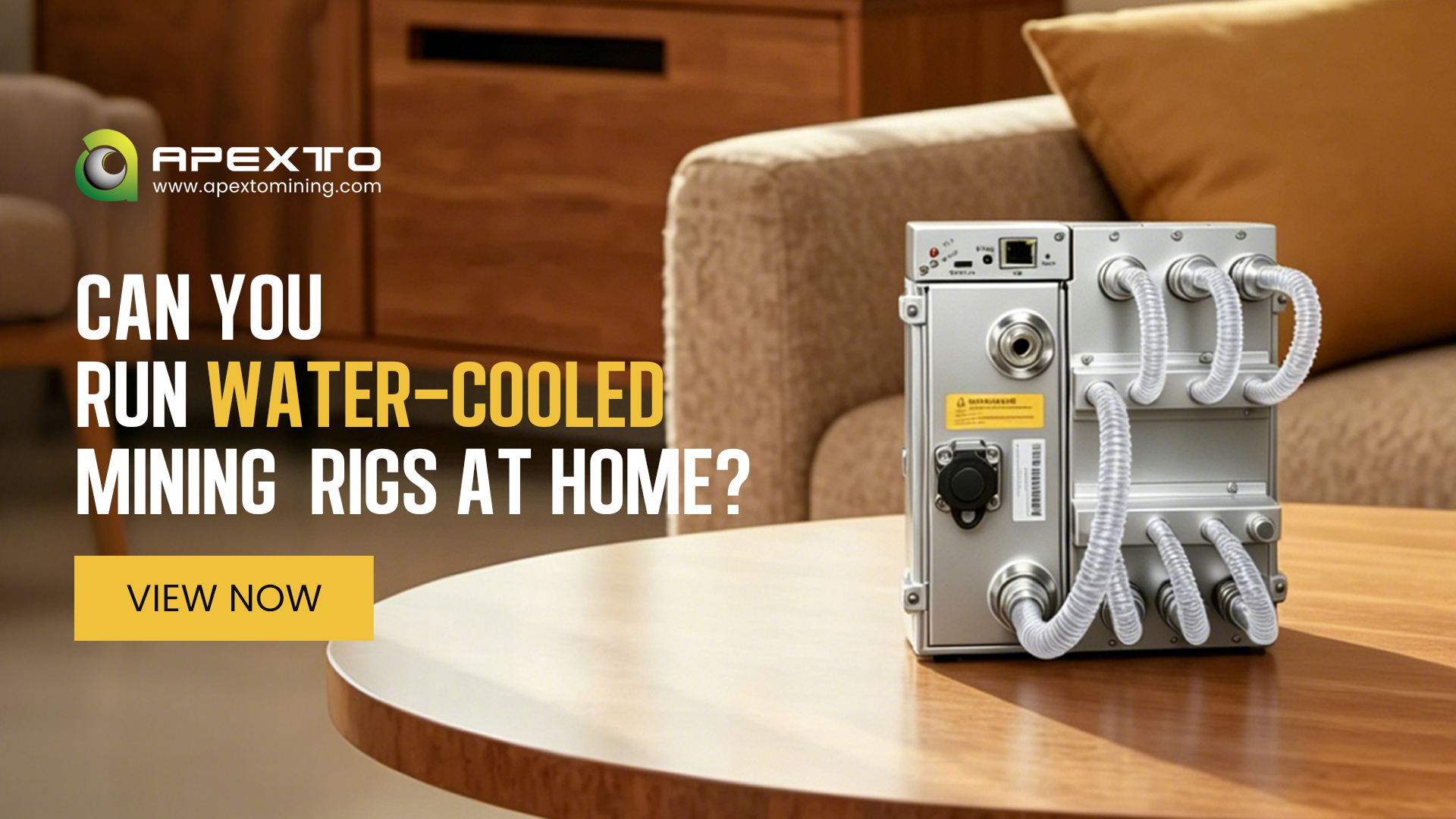
Yes — but only if you meet three conditions:
- 380V three-phase power (or a transformer solution for your property)
- Dry cooler placement outside your living space (or an AP-M2 compact radiator for 1–2 miners)
- Electricity cost at approximately $0.07/kWh or below (or meaningful heat recovery offset)
Without these, home hydro mining is usually impractical. Air-cooled ASIC miners are fundamentally incompatible with residential environments at 75–83 dB — water cooling solves the noise and heat problem, but introduces a serious infrastructure requirement that this guide covers in full. (Last updated: April 2026)
Introduction
Air-cooled ASIC miners are 75–83 dB—louder than a vacuum cleaner—and their exhaust heat makes them incompatible with basements, garages, and home offices. Water cooling changes both numbers: 45–50 dB and PCB temperatures 26–30°C lower. But the quiet comes with an infrastructure requirement that doesn’t fit every home: 380V three-phase electrical power. This guide examines the noise realities, thermal management challenges, and electrical requirements honestly—so you can decide if home hydro mining is actually viable for your situation.
The data comes from Bitmain’s official specifications for Antminer Hydro models, Apexto’s documented field experience with residential and small-scale deployments, and industry-standard acoustic and thermal engineering principles.
Air-Cooled vs Water-Cooled Mining at Home
This side-by-side comparison shows the fundamental differences for residential deployment:
| Factor | Air-Cooled ASIC | Water-Cooled ASIC (Hydro) |
|---|---|---|
| Typical Noise Level | 75–83 dB | 45–50 dB (miner) + 55–70 dB (dry cooler) |
| Full-Load PCB Temperature | 72–82°C | 41–52°C |
| Standard Electrical Requirement | 220V single-phase | 380V three-phase |
| Home Noise Compliance | Almost always violates residential limits | Compliant with proper placement |
| Waste Heat Recovery Potential | No | Yes (with heat exchanger option) |
| Typical Home Deployment Feasibility | ❌ Not practical for most | ✅ Possible with required infrastructure |
The Electrical Requirement — Water Cooled Miner Power Requirements (380V Three-Phase)
1.1 Why 380V Three-Phase Is the Standard for Industrial Miners
This is the part that makes or breaks home deployment.
Most industrial water-cooled ASIC miners—every current Antminer Hydro model including the Antminer S21 Hydro (335T), Antminer S21+ Hyd (358T), Antminer S21 XP Hyd (473T), Antminer S21 XP+ Hyd (500T), and Antminer S23 Hyd (580T)—are designed for 380–415V three-phase AC power. These miners use IEC 60309 industrial connectors and are engineered for three-phase distribution as the standard configuration. Standard residential electrical service in most countries is single-phase 220–240V (or 120V in the US), which differs from this requirement. Some deployments may use step-up transformers or alternative electrical configurations depending on regional setup and infrastructure availability—a qualified electrician can assess what applies in your specific case.
The three-phase requirement exists because high-power mining equipment draws too much current on single-phase power to be practical. At 5,676W, a single-phase 240V circuit would require nearly 24A continuous draw—possible in theory, but the voltage drop and current imbalance at that load makes three-phase the engineering-correct solution for equipment of this power class.
1.2 Your Three-Phase Options
| Option | Description | Cost Range | Time Required |
|---|---|---|---|
| Property already has three-phase | Commercial buildings, workshops, some rural homes | $0 | Immediate |
| Utility service upgrade | Contact electricity provider to run three-phase feed | $2,000–$8,000 (varies by distance) | 2–12 weeks |
| Three-phase step-up transformer | Converts existing single-phase 240V to three-phase 380V | $1,500–$4,000 | 1–3 days installation |
| Dedicated three-phase sub-panel | Adds a three-phase panel fed from main distribution board | $800–$2,500 | 1–2 weeks |
Three-phase installation is a licensed electrical job. Always use a qualified electrician and obtain required permits. Costs vary by region—get at least two quotes and confirm with your local utility before purchasing hydro mining equipment.
1.3 Electrical Load Planning
Here’s what the load looks like for home configurations of different scales:
| Scale | Miners | Total Miner Power | Cooling System | Total Load | Circuit Required |
|---|---|---|---|---|---|
| Ultra-compact | 1–2× S21 XP Hyd | 5.7–11.4 kW | AP-M2 (~0.2 kW) | ~6–12 kW | 16–32A dedicated circuit |
| Entry | 4× S21 Hydro | 21.4 kW | AP-H4 (~1.5 kW) | ~23 kW | 63A three-phase |
| Medium | 6× S21 XP Hyd | 34.1 kW | AP-H6 (~2.0 kW) | ~36 kW | 100A three-phase |
| Large | 9× S21 XP Hyd | 51.1 kW | AP-H9 (~2.5 kW) | ~54 kW | 160A three-phase |
| Maximum | 12× S21 XP+ Hyd | 66.0 kW | AP-H12 (~3.5 kW) | ~70 kW | 200A three-phase |
Note: Budget 15–20% headroom above nominal draw when sizing circuits. Miner power consumption varies by batch, ambient temperature, and operating conditions.
The Noise Problem — Hydro Mining Noise Levels Compared to Air Cooling
2.1 The Acoustic Reality of Air-Cooled ASICs
Air-cooled ASIC miners are loud because they have to be. Pushing hash rates of 300–580 TH/s through chips that consume 3,500–5,500W generates enormous heat. Moving that heat away requires large fans spinning at high RPM—typically 2,500–4,000 RPM for an air-cooled S21 or S23 operating at full load.
The result is 75–83 dB of broad-spectrum noise, with peaks in the 3–5 kHz range—the frequency range human ears are most sensitive to. This isn’t just annoying. It’s functionally incompatible with:
- Living spaces (bedrooms, home offices)
- Attached garages
- Basements with limited airflow
- Any environment where noise ordinances apply
Most residential noise regulations cap nighttime outdoor noise at 45–55 dB(A). An air-cooled ASIC miner at 78 dB violates that by 23–33 dB—roughly equivalent to the difference between a quiet library and a busy highway.
2.2 What Water Cooling Actually Changes
Water-cooled ASIC miners (Antminer Hydro series) operate their hashboard cooling with near-silent hydro pumps rather than high-RPM fans. The miners themselves produce 45–50 dB—comparable to a quiet library or normal conversation. This is not a marginal improvement. It’s a different category of deployment feasibility.
But—and this is where most articles oversimplify—the miner itself isn’t the only noise source. The cooling system’s dry cooler (which rejects heat to outdoor air) uses fans that run at 55–70 dB depending on ambient temperature and load. The total system noise in a home deployment depends heavily on where you place that dry cooler.
2.3 Noise Levels by Home Deployment Scenario
| Placement Scenario | Miner Noise | Dry Cooler Placement | Living-Space Noise |
|---|---|---|---|
| Dry cooler outdoors, miner in garage | 45–50 dB | Outside (not in living space) | ~45–50 dB |
| AP-M2 compact radiator (1–2 miners), in-room | 45–50 dB | N/A (replaces separate dry cooler) | 30–70 dB (variable fan speed) |
| Dry cooler in adjacent utility room | 45–50 dB | Muffled by walls (~10–15 dB attenuation) | ~55–60 dB |
| Dry cooler in same room, in-room | 45–50 dB | 55–70 dB (unattenuated) | 55–70 dB |
| Air-cooled ASIC in same room (reference) | 75–83 dB | N/A | 75–83 dB |
The AP-M2 compact radiator ($300) is unique in this table because it replaces the separate dry cooler entirely—it is the heat rejection device. At 30–70 dB with automatic fan speed control, it is the only option in the Apexto lineup that can genuinely run in a home office or living space without routing noise-generating equipment to another room. For 1–2 miner setups, this is the practical path to a truly quiet in-room installation.
2.4 Regulatory Compliance
| Jurisdiction Type | Typical Nighttime Limit | Air-Cooled ASIC (78 dB) | Water-Cooled Miner (cooler outside) |
|---|---|---|---|
| Urban residential | 45–55 dB(A) | Severe violation (23–33 dB over) | Compliant |
| Suburban residential | 50–55 dB(A) | Severe violation (23–28 dB over) | Compliant |
| Rural / agricultural | 55–65 dB(A) | Violation (13–23 dB over) | Compliant |
| Industrial / commercial zone | 65–75 dB(A) | Borderline (3–13 dB over) | Compliant |
The takeaway: air-cooled ASIC mining is functionally incompatible with virtually all residential zoning. Water-cooled mining, with proper dry cooler placement, can comply with most residential noise regulations.
Thermal Management — Water Cooling Works, But Heat Has to Go Somewhere
3.1 Why Water Cooling Eliminates Thermal Throttling
Air cooling at 75–83 dB is not just a noise problem. It’s a thermal constraint problem disguised as a noise problem.
Air has a specific heat capacity of 1.006 J/g·°C and thermal conductivity of 0.024 W/m·K. At the power densities of a 473 TH/s miner drawing 5,676W, air cooling reaches its practical limit. The result is PCB temperatures of 72–82°C under full load—not immediately destructive, but close enough to cause thermal throttling when ambient temperatures rise or airflow is restricted.
Water has a specific heat capacity of 4.18 J/g·°C and thermal conductivity of 0.6 W/m·K—over 4x the thermal storage capacity and 25x the conductivity of air. Water-cooled Antminer Hydro units maintain PCB temperatures of 41–52°C under identical load conditions. That 26–30°C margin eliminates thermal throttling entirely. Hash rates stay at rated specification continuously, not just in climate-controlled server rooms.
| Miner Model | Air-Cooled PCB Temp | Water-Cooled PCB Temp | Thermal Delta |
|---|---|---|---|
| Antminer S21 Hydro (335T) | 72–78°C | 41–46°C | ~27°C |
| Antminer S21+ Hyd (358T) | 72–78°C | 42–47°C | ~27°C |
| Antminer S21 XP Hyd (473T) | 74–80°C | 43–48°C | ~27°C |
| Antminer S21 XP+ Hyd (500T) | 74–80°C | 44–49°C | ~26°C |
| Antminer S23 Hyd (580T) | 74–82°C | 41–52°C | ~26–30°C |
3.2 Where Does the Heat Actually Go?
Water cooling relocates heat rather than eliminating it. Every watt of electrical power consumed by a miner becomes thermal energy that must be rejected somewhere. In a home deployment, this has three practical implications:
Implication 1: The dry cooler must have adequate airflow. Dry coolers reject heat to outdoor air. They need ambient temperatures below approximately 38°C to operate at full rated capacity and unobstructed airflow. Installing a dry cooler in a sealed, unventilated room causes it to recirculate its own waste heat—degrading cooling performance and potentially triggering miner thermal shutdown.
Implication 2: Closed-loop systems need insulated hose routing. Coolant lines carrying 40–50°C water through living spaces need insulation both to prevent heat loss to the room and to protect against physical damage. Apexto’s H-Series systems use EPDM hoses with quick-connect fittings—routing through walls or under floors is standard practice in residential installations.
Implication 3: Ambient temperature determines your effective capacity ceiling. In hotter climates, dry cooler efficiency drops significantly. A 35 kW-rated system does not deliver 35 kW of cooling when the outside air is 38°C+. Real thermal performance in hot climates may be 60–75% of rated capacity.
3.3 The Heat Recovery Option
Here is something air cooling structurally cannot offer: waste heat reuse.
All water-cooled mining systems move heat through a coolant loop. That loop can be routed through a plate heat exchanger to pre-heat domestic water, space heating radiators, or underfloor heating circuits. The H-Series systems with heat recovery option make this a configurable deployment choice.
At full load, a 6-miner AP-H6 system rejects approximately 32–34 kW of thermal energy through its coolant loop. In a 100–150 m² home during winter in a temperate climate, this can offset a meaningful portion of heating costs—effectively reducing your net electricity cost for mining.
The economic value of heat recovery depends on your local climate, home insulation, and heating fuel costs. In northern climates where winter heating bills are substantial, heat recovery can meaningfully shift the economics of home hydro mining.
System Reliability — Water Cooling Is More Reliable, With a Caveat
4.1 The Reliability Case for Water Cooling
Lower operating temperatures don’t just improve performance. They materially extend component life.
Air-cooled miners running at 72–82°C place sustained thermal stress on ASIC chips, solder joints, capacitors, and fans—the primary failure modes in air-cooled deployments are fan bearing failure, capacitor degradation, and solder joint fatigue, all of which are temperature-accelerated. Water-cooled miners operating at 41–52°C reduce the rate of all of these failure mechanisms.
Field experience across Apexto deployments consistently shows that water-cooled systems have lower annualized failure rates than comparable air-cooled systems in equivalent deployment conditions. The primary mechanism is straightforward: cooler components last longer.
4.2 The Reliability Caveat: Coolant System Failure Modes
Water cooling introduces its own failure modes that air cooling doesn’t have. Understanding them matters before you commit.
| Failure Mode | Frequency | Detection | Mitigation |
|---|---|---|---|
| Coolant leak | Most common | Pressure decay sensors; visual inspection | Factory-sealed quick-connect fittings; quarterly pressure verification |
| Pump failure | Moderate | Flow rate monitoring; vibration analysis | Redundant pump option on larger systems; automated thermal shutdown |
| Dry cooler fan failure | Moderate | Temperature rise alerts | Multiple fans on H-Series units provide redundancy; thermal shutdown protection |
| Block/chip contamination | Low | Flow rate drop; temperature rise | Filtration; deionized water with antifreeze and corrosion inhibitor |
| Electrical fault | Low | Circuit breakers; ground fault detection | Built-in protection standard on all H-Series units |
Critical point: All Antminer Hydro units have mandatory thermal shutdown protection. When PCB temperatures reach approximately 85°C, the miner powers down automatically. This means a cooling failure doesn’t immediately destroy your hardware—it gives you time to respond. Build that response time into your maintenance plan.
4.3 What Regular Maintenance Actually Looks Like
Maintenance for a home hydro mining system is more involved than an air-cooled setup, but not prohibitively so:
- Weekly: Visual inspection of coolant lines and connections
- Monthly: Coolant level check; fan and dry cooler cleanliness
- Every 6 months: Dry cooler fin cleaning with compressed air; pressure system verification
- Every 12 months: Pump performance check; electrical connection inspection by qualified electrician
- Every 24 months: Full coolant replacement (deionized water + antifreeze + corrosion inhibitor per manufacturer spec)
The coolant replacement interval is non-negotiable. Over time, antifreeze degrades and biocides lose effectiveness. Neglecting this increases risk of microbiological growth and galvanic corrosion in the stainless steel manifold.
Is Hydro Mining Profitable at Home? — Economics and ROI Reality
Mining profitability is almost entirely determined by your electricity rate. Not hardware efficiency. Not miner model. Your electricity rate.
This is true for all mining, but it’s especially true for home hydro mining, where you’ve added the cost of three-phase electrical infrastructure and a dedicated cooling system on top of the miner purchase. The ROI calculation always starts with this question: At my electricity rate, does mining revenue exceed mining costs?
5.1 Profitability Scenarios (April 2026: BTC ~$71,000, Difficulty ~138T)
Using the Antminer S21 XP Hydro (473 TH/s, 5,676W) as the example miner:
| Electricity Rate | Daily Revenue/Miner | Daily Cost/Miner | Daily Net/Miner | Annual Net (6 miners) | ROI Timeline |
|---|---|---|---|---|---|
| $0.04/kWh | ~$15.90 | ~$5.40 | +$10.50 | ~$23,000 | ~2–3 years (with infrastructure) |
| $0.07/kWh | ~$15.90 | ~$9.50 | +$6.40 | ~$14,000 | ~3–5 years |
| $0.10/kWh | ~$15.90 | ~$13.60 | +$2.30 | ~$5,000 | ~8–10 years |
Data note: Daily mining revenue based on Antminer S21 XP Hydro 473T at BTC $71,000 and network difficulty ~138T, yielding approximately $14.50–$15.90/day per unit. Infrastructure CapEx (hydro cooling system $1,500–$5,000, electrical upgrade $1,500–$5,000, installation labor $500–$1,500) totals approximately $5,000–$10,000. Total system CapEx for 6 miners (unit cost ~$5,000–$7,200 each) plus infrastructure runs approximately $35,000–$55,000. Always verify current figures at ASICMinerValue or WhatToMine before committing capital.
5.2 The Honest Assessment
The data shows the economic boundaries clearly. At $0.07/kWh, a 6-miner home hydro deployment generates approximately $14,000/year in net revenue after electricity—but that has to cover maintenance, internet, and eventually hardware replacement. Infrastructure amortization makes the true payback period longer than it looks.
At $0.10/kWh and above, home hydro mining becomes increasingly difficult to justify financially without a meaningful heat recovery credit.
Context for decision-making:
- Solar panel ROI: 5–7 years
- Commercial real estate: 7–10 years
- Industrial ASIC mining (favorable electricity): 14–24 months
- Home hydro mining at $0.07/kWh: viable but with 3–5 year infrastructure payback
- Home hydro mining at $0.10/kWh: difficult without heat recovery credit
- Hosted mining at $0.06/kWh all-in: often better ROI than home deployment at high residential electricity rates
If your electricity rate is above $0.08/kWh without a credible heat recovery offset, hosted mining arrangements (where a data center provides power and cooling at $0.05–$0.07/kWh all-in) will almost always outperform a home deployment on a pure ROI basis.
Your Decision Framework
Answer these five questions before spending any money:
Question 1: Do you have or can you install three-phase power? If no, explore step-up transformer options with a qualified electrician. Transformers add $1,500–$4,000 and some complexity—but they can make deployment possible on a standard single-phase service. If transformer installation isn’t feasible for your property, home hydro mining may not be practical at this stage.
Question 2: Where will the dry cooler live? If you cannot place it outdoors, in a garage, or in an adjacent utility room, your living-space noise will be 55–70 dB. If you need in-room operation with the primary noise source in the same room, the AP-M2 compact radiator is the only realistic option for 1–2 miners.
Question 3: What’s your electricity rate? If above $0.08/kWh without heat recovery offset, home hydro mining is unlikely to be profitable at current BTC prices. Hosted mining is a better path.
Question 4: How many miners are you running? A single miner cannot justify the infrastructure cost of three-phase electrical installation. The economics of home three-phase only work at 4+ miners. If you’re starting with 1–2, the AP-M2 on a dedicated circuit is the practical entry point.
Question 5: What’s your time horizon? ASIC miners depreciate with each generation. If you’re planning to operate for less than 2 years, infrastructure amortization makes the economics worse than they look.
Recommended Setup by Scenario
Not sure which configuration fits your situation? This section maps specific hardware pairings to deployment scales and use cases—so you can move from technical understanding to a concrete purchasing decision.
| Scale | Use Case | Recommended Miner | Recommended Cooling | Notes |
|---|---|---|---|---|
| 1–2 miners | Home office, living space, single room | Antminer S21 XP Hydro (473T) | AP-M2 compact radiator ($300) | No separate dry cooler needed; fits in-room; fan speed auto-adjusts 30–70 dB |
| 4–6 miners | Garage, basement, dedicated room | Antminer S21 XP+ Hyd (500T) | AP-H6 hydro cooling cabinet ($2,285–$3,100) | Dedicated dry cooler; three-phase 380V required; 35 kW capacity |
| 8–12 miners | Semi-industrial, converted space | Antminer S23 Hyd (580T) | AP-H12 hydro cooling cabinet ($2,785–$5,000) | Maximum home-scale capacity; 70 kW cooling; separate dry cooler required |
How to use this table: Match your target scale to the row that fits. If you’re planning 6 miners but aren’t sure between entry and medium, the AP-H6 handles 6 units comfortably and leaves room to scale up within the same infrastructure footprint.
Important: All configurations above require 380V three-phase electrical service or a step-up transformer. Verify your property’s electrical capacity with a licensed electrician before purchasing. For custom configurations or volume pricing, contact Apexto’s sales team.
Conclusion
Water-cooled ASIC mining can work at home—but only if you have or can install three-phase electrical service, and only if your electricity rate is low enough (or your heat recovery offset valuable enough) to make the economics work.
The technology is proven. The acoustic and thermal performance advantages over air cooling are real. Whether you’re a home miner or managing a full-scale mining farm, Apexto’s hydro cooling and dry cooler systems are designed to fit your exact setup—from the AP-M2 compact radiator ($300) for 1–2 miner home office setups to the Apexto H-Series (AP-H4 through AP-H12) for 4–12 miner deployments.
The honest answer to “can I run water-cooled mining rigs at home?” is: Yes, if your home has three-phase power and your electricity rate is approximately $0.07/kWh or below. Otherwise, hosted mining is almost certainly the better financial decision.
Contact Apexto’s sales team for system configuration guidance and real-time pricing based on your deployment scale.
No. All Antminer Hydro models are designed for 380–415V three-phase power as the standard configuration. Standard residential outlets provide 220–240V single-phase, which differs from this requirement. Some deployments use step-up transformers or alternative electrical configurations—consult a qualified electrician to assess what applies to your property. This is a significant infrastructure consideration that should be confirmed before purchasing hydro mining equipment.
Typically $2,000–$8,000 in urban areas, depending on distance from the nearest three-phase distribution transformer. Rural areas can cost significantly more. Get quotes from at least two licensed electricians and confirm timeline with your utility provider.
Yes—but only if the dry cooler is placed outside your living space. The miner itself runs at 45–50 dB. The dry cooler runs at 55–70 dB. If both are in the same room, you're at 55–70 dB total—better than air cooling's 75–83 dB, but not library-quiet.
The H-Series systems with heat recovery option route the coolant loop through a plate heat exchanger. This pre-heats water that can feed your home's radiator circuit, underfloor heating, or domestic hot water. It doesn't eliminate your heating bill—it offsets part of it with waste heat that would otherwise be rejected to outdoor air.
Antminer Hydro units have mandatory thermal shutdown protection at approximately 85°C PCB temperature. If coolant circulation stops, the miner shuts down automatically before sustained damage occurs. You lose mining time, but you don't automatically destroy the hardware.
More than air cooling, less than most people fear. Weekly visual checks, monthly coolant level checks, bi-annual dry cooler cleaning, and a full coolant replacement every 24 months. The coolant replacement is the most involved task and typically takes 1–2 hours.
Four is the practical minimum to justify three-phase electrical infrastructure costs. Below four miners, the infrastructure cost per miner is too high to achieve reasonable ROI. One to two miners can work with the AP-M2 on a standard dedicated circuit.
In principle, yes. Lower operating temperatures (41–52°C vs 72–82°C) reduce thermal stress on all components. However, field data on actual lifespan improvement is proprietary to large mining operators and not publicly available. Treat this as a likely benefit rather than a guaranteed one.
Only if the building has or can accommodate three-phase electrical service—which is rare for residential apartments. Most apartment electrical setups max out at single-phase 220V. A single-family home with a garage or basement is the realistic target environment.
Yes, for 1–2 miners. The AP-M2 is a 12 kW compact radiator with automatic fan speed control (30–70 dB) that replaces the need for a separate dry cooler. Its small footprint (56 × 45 × 15 cm) and low power draw (130–200W) make it the most practical path to genuinely quiet in-room mining. For more than 2 miners, you'll need an H-Series cabinet and must route the dry cooler outside your living space.
Yes—but the answer depends heavily on your infrastructure and electricity costs. Air-cooled ASIC miners are generally not practical for home environments due to noise levels of 75–83 dB. Water-cooled ASIC miners (Antminer Hydro series) reduce this to 45–50 dB and enable home deployment, but require 380V three-phase electrical service and an electricity rate of approximately $0.07/kWh or below to be financially viable.

About Ada
I am a Data Analyst at Apexto Mining, with experience in the cryptocurrency mining industry since 2017. My work focuses on analyzing ASIC performance, thermal efficiency, and mining profitability, especially in hydro and immersion cooling environments. I contribute to technical research and content creation, including blog articles and educational materials on mining hardware and infrastructure optimization. I also work closely with engineering and sales teams to translate technical data into practical insights for customers and partners. I believe mining technology should be communicated clearly and transparently, supported by real data and measurable performance. Outside of work, I enjoy yoga, reading, and traveling.
View all posts by AdaRelated posts
Blockchain vs Cryptocurrency: The Fundamental Difference Every Miner Needs to Understand

Bitcoin Mining Software: The Complete Beginner’s Guide to Choosing and Using Mining Tools in 2026
Who Are Water-Cooled Miners Suitable For? A Reference Guide for 5 User Categories
Bitcoin Mining Profitability & ASIC Buyer’s Guide — April 2026
2026 Water-Cooled ASIC Miners: Complete Guide from Home to Industrial Mining
Summer Water-Cooled ASIC Miner Maintenance: A Practical Guide for 2026
Search Blog
Recent Posts


Join our community


For media inquiries, please contact
info@apexto.com.cn


