 Bitmain Antminer
 IceRiver
 Whatsminer
 Canaan Avalon
 Goldshell
 Solo Miner
 Elphapex
 Volcminer
 Jasminer
 Pinecone
 Bitcoin
 Dogecoin
 Aleo
Aleo
 Kaspa
Kaspa
 ALPH
ALPH
 Nexa
Nexa
 ETC
ETC
 CKB
CKB
 Dash
Dash
 Kadena










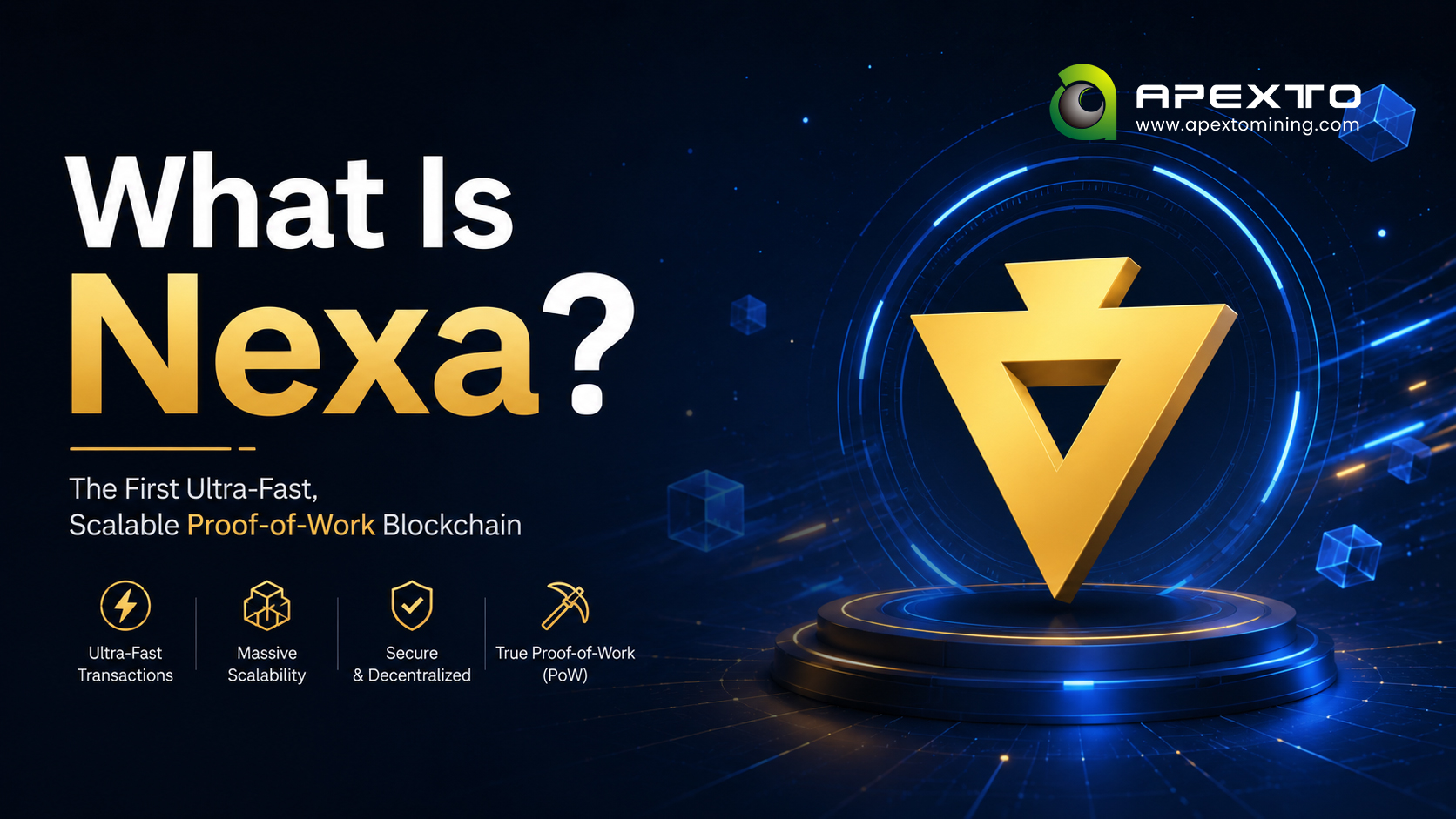
In the rapidly evolving landscape of blockchain technology, new projects emerge daily, each promising to solve fundamental challenges or unlock unprecedented capabilities. Among these, Nexa has gained attention as a next-generation infrastructure project designed to address persistent limitations in existing blockchain ecosystems. This comprehensive overview examines what Nexa is, how it came to be, its technical architecture, real-world applications, and—critically—the risks and challenges that potential users and investors must understand.
What Is Nexa? Beyond the Hype
Nexa is not merely another cryptocurrency token; it represents a holistic blockchain infrastructure project with ambitions to become foundational technology for decentralized applications. At its core, Nexa aims to bridge the gap between theoretical blockchain potential and practical, scalable implementation. Unlike first-generation blockchains that prioritized either security (Bitcoin) or programmability (Ethereum), Nexa was conceived as a “third-way” platform that seeks to optimize for three critical dimensions simultaneously: scalability, sustainability, and sovereignty.
The name “Nexa” itself reflects this forward-looking orientation—it suggests “next,” “nexus,” and “nexus point,” symbolizing both chronological progression and architectural centrality. Rather than positioning itself as a competitor to existing ecosystems, Nexa’s philosophy emphasizes interoperability and augmentation, designed to work alongside rather than replace established networks.
The Genesis Story: From Concept to Reality
Nexa’s origins trace back to 2021, during a period of intense reflection within the blockchain community following Ethereum’s network congestion crises and growing environmental concerns about proof-of-work consensus mechanisms. A coalition of researchers, engineers, and cryptography experts—many with backgrounds in distributed systems and academic computer science—began collaborating on what they termed “Project Nexus”: an exploration of whether blockchain fundamentals could be reimagined for the next decade of digital infrastructure.
What began as an academic research initiative evolved into a concrete development effort by early 2022. The team published their initial white paper in March 2022, outlining core principles that would guide Nexa’s development:
- Radical Efficiency: Every component must minimize computational overhead without compromising security
- User Sovereignty: Technical design must prioritize user control over convenience
- Ecosystem Harmony: Native support for cross-chain interactions must be built-in, not bolted-on
Unlike many blockchain projects that launched with significant venture capital backing and aggressive marketing campaigns, Nexa adopted a deliberately measured approach. Its testnet launched in Q4 2022 with limited public access, focusing on rigorous security audits and performance benchmarking. The mainnet followed in June 2023 after extensive stress testing across diverse hardware configurations and network conditions.
This conservative launch strategy reflected Nexa’s philosophical foundation: that blockchain infrastructure, like physical infrastructure, must be reliable before it can be ubiquitous. The project’s governance model also emerged from this principle—initially centralized for technical stability, with a carefully orchestrated transition toward community governance planned over a multi-year timeline.
Technical Architecture: The Three-Layer Innovation
Nexa’s technical architecture represents a significant departure from conventional blockchain designs. Rather than implementing a single monolithic solution, Nexa employs a sophisticated three-layer structure that separates concerns while maintaining tight integration.
Layer 1: The Adaptive Consensus Engine
At the foundation lies Nexa’s consensus mechanism, which the team refers to as “Adaptive Proof-of-Stake” (APoS). Unlike traditional proof-of-stake systems where validators are selected based primarily on stake size, APoS incorporates multiple dynamic factors:
- Network Health Metrics: Validators are evaluated on real-time metrics including uptime, latency, and bandwidth consistency
- Geographic Distribution: The protocol actively incentivizes validator participation across diverse geographic regions to enhance decentralization
- Resource Efficiency: Validators demonstrating superior energy efficiency receive additional rewards, aligning economic incentives with environmental sustainability
Perhaps most innovatively, APoS features “adaptive difficulty”—the consensus parameters automatically adjust based on network load. During periods of low activity, the system optimizes for maximum security and finality. During high-demand periods, it temporarily prioritizes throughput while maintaining cryptographic guarantees of eventual consistency.
Layer 2: The Modular Execution Environment
Nexa’s execution layer breaks from the “one-size-fits-all” smart contract model. Instead, it implements a modular architecture where different execution environments can coexist:
- ZK-Rollup Environment: For applications requiring maximum scalability and privacy, utilizing zero-knowledge proofs for off-chain computation with on-chain verification
- WASM Environment: A WebAssembly-based runtime optimized for developer familiarity and cross-platform compatibility
- Lightweight Script Environment: A minimal, highly efficient scripting language designed specifically for simple value transfers and basic conditional logic
This modularity allows developers to select the appropriate environment for their specific use case, avoiding the performance penalties of running complex computations in environments optimized for simplicity, or vice versa.
Layer 3: The Data Availability and Storage Network
Recognizing that data availability is often the bottleneck in blockchain scalability, Nexa implements a novel data layer called “Distributed Ledger Storage” (DLS). This layer addresses the fundamental tension between data permanence and storage costs:
- Tiered Storage Model: Transactional data is stored immutably on-chain, while supplementary data (metadata, proofs, application state) can be stored in a distributed network of storage nodes with cryptographic commitments
- Proof-Based Verification: Applications can verify data integrity without storing the complete dataset locally, using compact cryptographic proofs
- Dynamic Storage Pricing: Storage costs adjust based on network-wide storage utilization, creating market-driven incentives for efficient data management
The DLS layer enables applications that were previously impractical on blockchain—such as decentralized video streaming, real-time IoT data processing, and complex simulation environments—by decoupling computation from permanent storage requirements.
Real-World Applications and Use Cases
Nexa’s design philosophy emphasizes practical utility over theoretical elegance. Several key application domains demonstrate its potential impact:
Sustainable Supply Chain Management
Traditional supply chain tracking relies on centralized databases vulnerable to manipulation and single points of failure. Nexa’s architecture enables end-to-end provenance tracking with minimal overhead. Each participant in a supply chain—from raw material extraction to retail distribution—can cryptographically attest to product status, with all attestations verified against Nexa’s consensus layer. The tiered storage model ensures that only essential verification data remains on-chain, while detailed documentation and multimedia evidence can be stored efficiently off-chain.
Decentralized Identity and Credentials
Nexa’s focus on user sovereignty makes it particularly well-suited for self-sovereign identity solutions. Users maintain complete control over their digital identities, issuing verifiable credentials that can be selectively disclosed to service providers. Unlike centralized identity systems, there is no central authority that can revoke or modify credentials without user consent. The adaptive consensus ensures that identity verification remains available even during periods of network stress.
Microtransaction Economies
The combination of near-zero transaction fees and sub-second confirmation times enables entirely new economic models. Content creators can implement pay-per-view microtransactions for individual articles or videos. IoT device networks can establish machine-to-machine payment systems for resource sharing. Real-time data marketplaces can facilitate instantaneous exchanges of sensor data between autonomous systems.
Cross-Chain Financial Infrastructure
Nexa’s native interoperability features position it as potential infrastructure for decentralized finance. Rather than building isolated DeFi ecosystems, Nexa enables seamless asset transfers and composability across multiple blockchain networks. Its consensus mechanism includes built-in bridges to major ecosystems, with security guarantees derived from its own validation process rather than relying on external oracles.
Critical Risk Assessment: Understanding the Challenges
While Nexa presents an ambitious and technically sophisticated vision, it’s essential to approach any blockchain project with clear-eyed awareness of potential risks and challenges. A balanced assessment requires examining technological, economic, regulatory, and adoption-related factors.
Technological Risks
The most immediate risk lies in the complexity of Nexa’s multi-layer architecture. While modular design offers significant advantages, it also increases the attack surface and creates potential failure points at layer boundaries. The adaptive consensus mechanism, while innovative, introduces additional complexity in security analysis. Traditional security audits focus on static protocols, but adaptive systems require continuous monitoring and evaluation as parameters change.
Additionally, Nexa’s reliance on novel cryptographic primitives—including specialized zero-knowledge proof implementations—means that vulnerabilities may exist that haven’t yet been discovered or publicly documented. Cryptographic research is an ongoing field, and what appears secure today may be compromised by future mathematical breakthroughs.
Economic and Market Risks
Like all blockchain projects, Nexa faces significant economic uncertainties. The tokenomics model—governing how the native NEXA token is distributed, used, and valued—represents a critical vulnerability. If the economic incentives don’t align with desired network behavior, the system could experience validator centralization, spam attacks, or economic instability.
Market volatility presents another substantial risk. Cryptocurrency markets are notoriously unpredictable, and price fluctuations can significantly impact network security. In proof-of-stake systems, validator profitability directly influences participation rates. Significant price drops could lead to validator exits, potentially compromising network security and decentralization.
Regulatory Uncertainty
The regulatory landscape for blockchain technology remains in flux globally. Nexa’s focus on user sovereignty and censorship resistance, while philosophically aligned with blockchain’s foundational principles, may conflict with emerging regulatory requirements in various jurisdictions. Compliance requirements around know-your-customer (KYC) procedures, anti-money laundering (AML) regulations, and securities classifications could pose significant challenges for widespread adoption.
Regulatory actions against similar projects have demonstrated how quickly the legal environment can change. What begins as regulatory ambiguity can rapidly evolve into enforcement actions that fundamentally alter a project’s operational parameters.
Adoption and Network Effects
Perhaps the most significant challenge facing Nexa is the “chicken-and-egg” problem common to all platform technologies: network effects require adoption, but adoption requires compelling applications. Without a robust ecosystem of applications and users, Nexa risks becoming a technically impressive but practically irrelevant infrastructure project.
Building developer mindshare in a crowded marketplace requires significant resources and strategic partnerships. The project’s conservative launch approach, while prudent from a security perspective, may have delayed the development of a vibrant ecosystem compared to more aggressively marketed competitors.
Environmental Considerations
While Nexa’s proof-of-stake consensus eliminates the energy-intensive mining process associated with Bitcoin, it’s important to recognize that blockchain infrastructure still consumes significant computational resources. The environmental impact of running thousands of validator nodes, storage nodes, and execution environments represents a non-trivial consideration, particularly as global focus on sustainability intensifies.
Conclusion: A Balanced Perspective on Next-Generation Infrastructure
Nexa represents an important evolution in blockchain thinking—a move away from incremental improvements toward fundamental reimagining of infrastructure constraints. Its three-layer architecture, adaptive consensus mechanism, and focus on practical utility demonstrate a sophisticated understanding of the challenges facing decentralized systems.
However, the path from technical promise to real-world impact is rarely straightforward. The risks outlined above—technological complexity, economic uncertainty, regulatory ambiguity, adoption challenges, and environmental considerations—represent significant hurdles that must be navigated thoughtfully.
For organizations and individuals considering engagement with Nexa, the appropriate approach is one of informed experimentation rather than wholesale commitment. Begin with small-scale implementations that test specific capabilities without exposing critical operations. Monitor the project’s development closely, paying particular attention to security audit results, ecosystem growth metrics, and regulatory developments.
The ultimate measure of Nexa’s success won’t be found in white papers or technical specifications, but in whether it enables new capabilities that were previously impossible, enhances existing systems without compromising their integrity, and does so in a manner that is sustainable, accessible, and aligned with human values.
As blockchain technology continues its journey from financial experiment to critical infrastructure, projects like Nexa represent our collective attempt to build digital foundations that serve humanity’s needs—not just technologically, but ethically and sustainably. The question isn’t whether Nexa will succeed or fail, but what lessons its development teaches us about building better digital infrastructure for the decades ahead.

About Ada
I am a Data Analyst at Apexto Mining, with experience in the cryptocurrency mining industry since 2017. My work focuses on analyzing ASIC performance, thermal efficiency, and mining profitability, especially in hydro and immersion cooling environments. I contribute to technical research and content creation, including blog articles and educational materials on mining hardware and infrastructure optimization. I also work closely with engineering and sales teams to translate technical data into practical insights for customers and partners. I believe mining technology should be communicated clearly and transparently, supported by real data and measurable performance. Outside of work, I enjoy yoga, reading, and traveling.
View all posts by AdaSearch Blog
Recent Posts


Join our community


For media inquiries, please contact
info@apexto.com.cn


