Bitmain Antminer
 IceRiver
 Whatsminer
 Canaan Avalon
 Goldshell
 Solo Miner
 Elphapex
 Volcminer
 Jasminer
 Pinecone
 Bitcoin
 Dogecoin
 Aleo
Aleo
 Kaspa
Kaspa
 ALPH
ALPH
 Nexa
Nexa
 ETC
ETC
 CKB
CKB
 Dash
Dash
 Kadena









The Scrypt mining industry is entering a phase where traditional air-cooled ASIC architecture is reaching its physical and economic limits. Heat density, energy inefficiency, and infrastructure constraints are forcing large-scale miners to shift toward hydro-cooled systems.
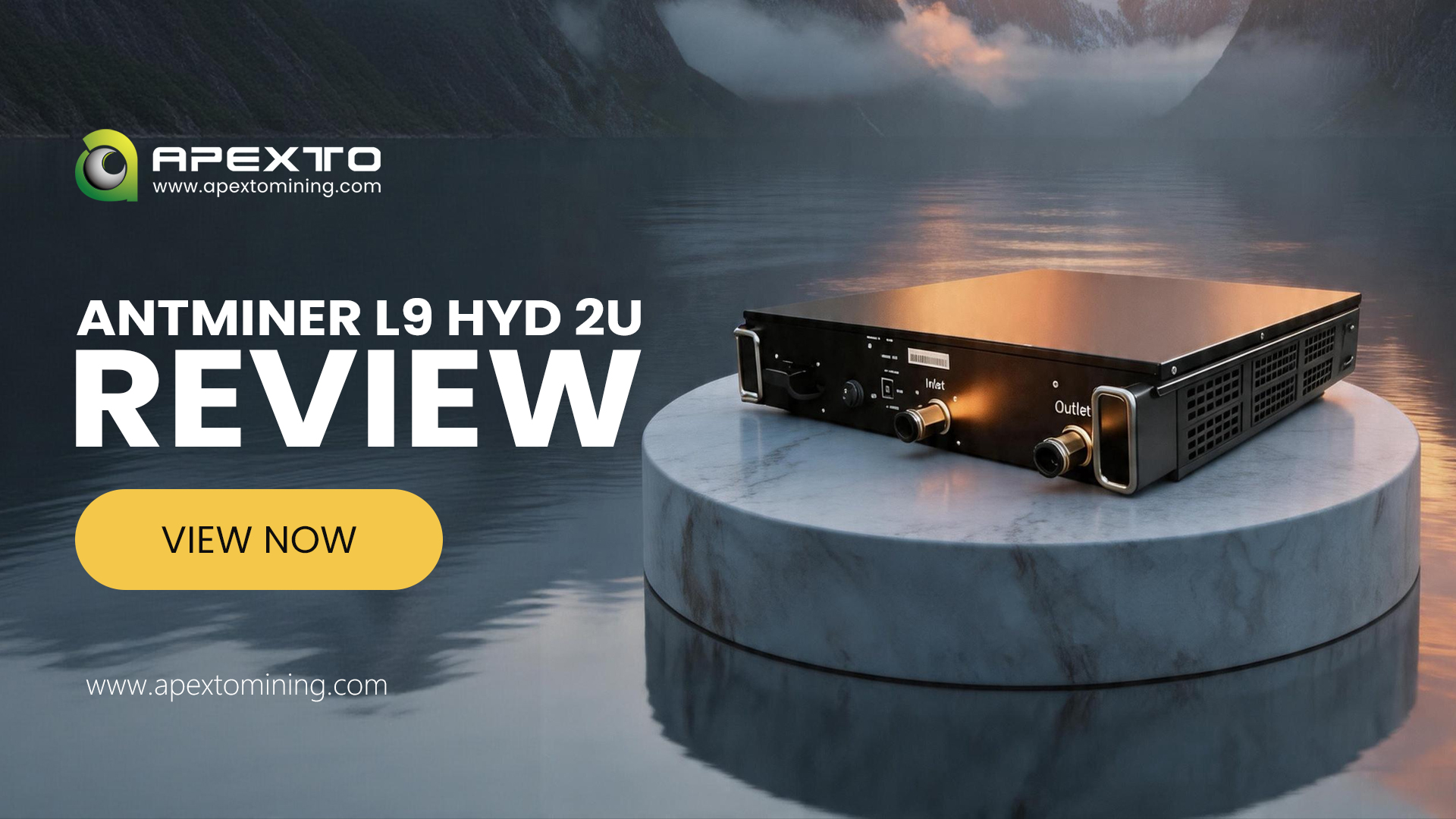
Among these next-generation solutions, the Bitmain Antminer L9 Hyd 2U represents a transition from standalone mining hardware to rack-level industrial computing infrastructure.
This article provides a deep technical and economic breakdown of its design, deployment requirements, and real-world profitability under 2026 mining conditions.
1. System Overview: What the L9 Hyd 2U Actually Is
The Bitmain Antminer L9 Hyd 2U is not a conventional ASIC miner in the traditional sense. It is best understood as a hydro-cooled Scrypt computing module designed for data-center scale deployment.
Unlike air-cooled machines that rely on high-speed fans and ambient airflow, this system uses a closed-loop liquid cooling architecture to directly manage thermal output at the chip level.
Key Technical Specifications (Expanded View)
- Algorithm: Scrypt (used for Litecoin and Dogecoin mining)
- Hashrate: ~27 GH/s (sustained under full load conditions)
- Power Consumption: ~5.6 kW per unit
- Cooling Method: Closed-loop hydro cooling (liquid-based heat exchange)
- Physical Design: 2U rack-mounted chassis
- Deployment Environment: Industrial mining farms / containerized data centers
What makes this system significant is not raw hashrate, but its ability to maintain stable performance under continuous 24/7 thermal stress conditions.
2. 2U Rack Architecture: Why Physical Design Directly Impacts Profitability
The “2U” classification refers to a standardized server rack measurement used in enterprise data centers. One “U” equals 1.75 inches of vertical rack space, meaning a 2U device occupies two full rack units.
In the case of the Bitmain Antminer L9 Hyd 2U, this design choice is not cosmetic—it directly affects mining economics.
2.1 High-Density Mining Layout Efficiency
In industrial mining, physical space is directly tied to revenue density.
A 2U hydro-cooled miner enables:
- Higher hash rate per rack unit
- Reduced wasted vertical airflow space
- Scalable deployment in standardized server racks
- Predictable infrastructure planning for MW-scale farms
👉 In practice, this means a mining farm can increase computational output without expanding building footprint.
2.2 Hydro Cooling Integration at Rack Level
Traditional air-cooled ASIC miners require external airflow management, which becomes inefficient in dense environments.
In contrast, the 2U hydro system integrates directly into:
- Liquid cooling distribution units (CDU)
- Heat exchange systems at facility level
- Centralized thermal management loops
This eliminates localized overheating zones, which are one of the primary causes of ASIC throttling and premature hardware degradation.
2.3 Power Distribution Optimization
At high density, electrical inefficiency becomes a hidden cost driver.
The 2U design allows:
- Shorter internal power paths
- Standardized PDU integration in racks
- Reduced voltage fluctuation risk
- More stable current distribution per unit
👉 This improves long-term uptime consistency, which directly impacts mining profitability.
3. Hydro Cooling Engineering: Why It Changes Mining Economics
Hydro cooling is often misunderstood as a “performance upgrade.” In reality, it is a thermal stability system rather than a raw performance enhancer.
3.1 Thermal Stability vs Peak Performance
Air-cooled systems suffer from:
- Temperature spikes under load
- Fan degradation over time
- Uneven chip temperature distribution
- Frequent frequency throttling
Hydro systems, such as those used in the Bitmain Antminer L9 Hyd 2U, solve this by maintaining:
- Uniform ASIC chip temperature
- Reduced thermal cycling stress
- Stable voltage-frequency curves
👉 This does not increase theoretical hashrate, but it preserves actual realized hashrate over time.
3.2 Long-Term Hardware Degradation Reduction
ASIC chips degrade faster under thermal stress. Hydro cooling reduces:
- Silicon wear rate
- Solder joint fatigue
- PCB thermal expansion stress
Over time, this results in:
👉 Lower failure rate + higher operational lifespan
4. Deployment Requirements: The Real Barrier to Entry
One of the most misunderstood aspects of hydro mining is infrastructure dependency.
To operate the Bitmain Antminer L9 Hyd 2U, operators must already have industrial-grade infrastructure in place.
4.1 Electrical Infrastructure Requirements
- 3-phase industrial power (typically 380–415V)
- Stable load distribution systems
- Dedicated circuit protection for ~5.6 kW per unit
- Industrial-grade PDUs and breakers
Without this, operational instability becomes a major risk factor.
4.2 Cooling Infrastructure Requirements
Hydro mining requires:
- Closed-loop coolant circulation systems
- Pumping units and flow controllers
- Heat exchangers or cooling towers
- Leak detection and emergency shutoff systems
👉 This effectively places hydro mining in the same category as data center engineering, not retail electronics.
4.3 Operational Requirements
Operators must also manage:
- Continuous temperature monitoring
- Flow rate balancing across racks
- Preventive maintenance cycles
- Fault detection and redundancy planning
5. Profitability Analysis: What Actually Determines ROI
Mining profitability is not determined by hardware alone. It is a system-level equation:
5.1 Electricity Cost Dominance
At $0.05–$0.08/kWh, electricity typically accounts for 60–80% of total operational cost.
Even small differences in power efficiency significantly impact net profitability.
5.2 Uptime Efficiency (Hidden Profit Driver)
Hydro cooling improves uptime reliability:
- Air-cooled systems: ~92–95%
- Hydro-cooled systems: ~97–99%
This difference may appear small, but over long timeframes it compounds into significant revenue variance.
5.3 Market Volatility Impact
Scrypt mining profitability is directly influenced by:
- Litecoin price cycles
- Dogecoin demand fluctuations
- Network difficulty adjustments
Realistic ROI Scenarios
- Bull market conditions: ~10–14 months
- Stable market conditions: ~14–20 months
- Bear market conditions: ~20–30+ months
👉 There is no fixed ROI in ASIC mining due to market volatility.
6. Risk Factors Most Investors Underestimate
6.1 Infrastructure CAPEX
Hydro systems require additional upfront investment beyond mining hardware.
6.2 Maintenance Complexity
Liquid systems introduce additional failure points:
- Pump wear
- Seal degradation
- Connector leakage risk
6.3 Hardware Obsolescence Cycle
Most ASIC miners have an effective economic lifespan of 18–36 months before efficiency becomes non-competitive.
7. Strategic Industry Shift: Mining as Infrastructure
The introduction of systems like the Bitmain Antminer L9 Hyd 2U reflects a deeper structural shift in mining economics:
The industry is transitioning from “hardware competition” to “infrastructure efficiency competition.”
Future mining profitability will depend more on:
- Power density optimization
- Cooling system efficiency
- Facility-level engineering design
- Operational uptime control
8. Conclusion
The Bitmain Antminer L9 Hyd 2U is not simply a more powerful ASIC miner. It is a hydro-cooled industrial computing system designed for high-density Scrypt mining environments.
Its value is defined not by peak hashrate, but by:
- Thermal stability under continuous load
- Rack-level deployment efficiency
- Long-term operational reliability
👉 In practical terms:
It is an infrastructure asset, not a consumer mining device.