


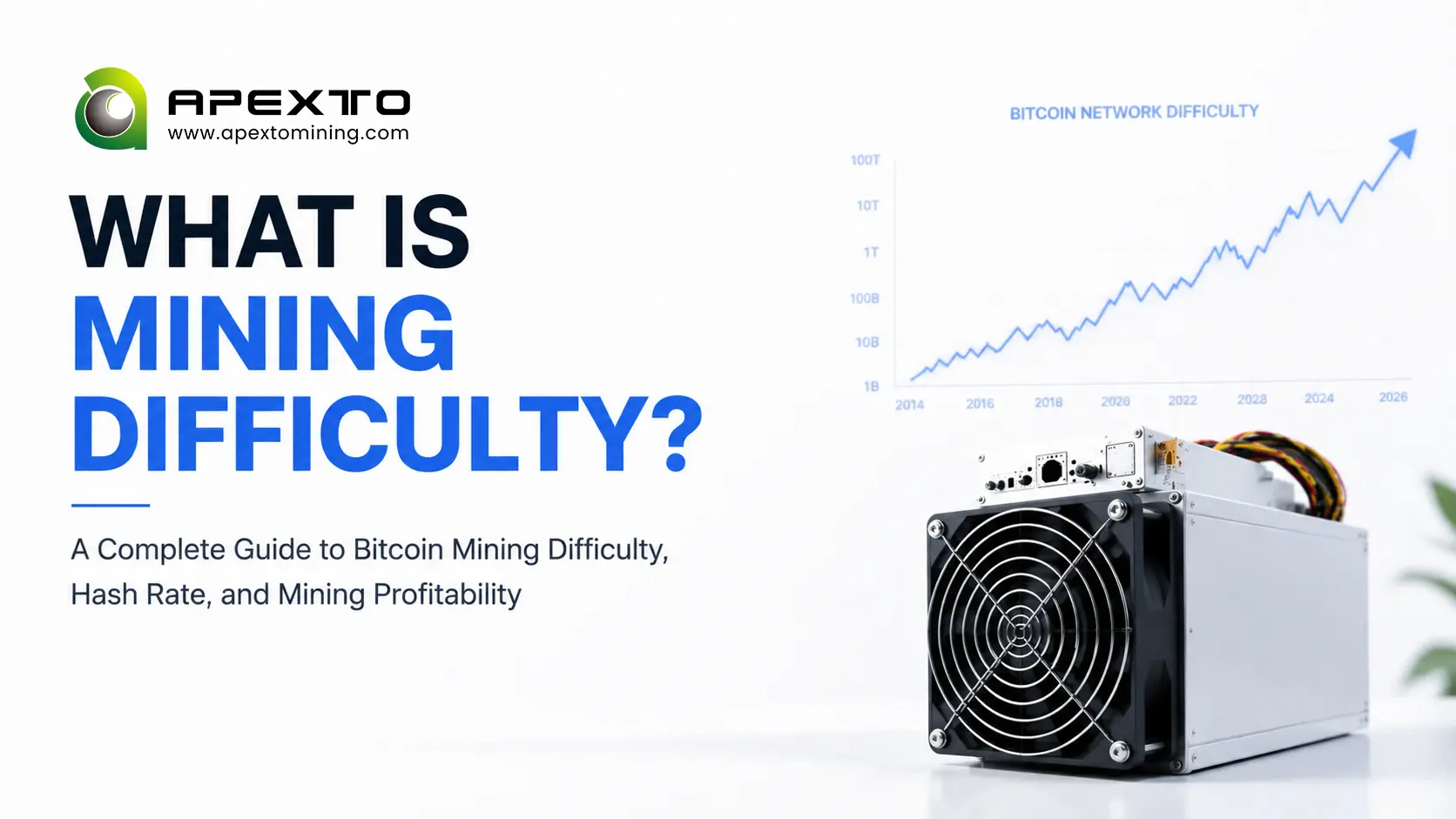
When evaluating cryptocurrency mining equipment, most prospective buyers concentrate on three immediate figures: hash rate (measured in Terahashes or Petahashes per second), power consumption (Watts), and hardware purchase price. While these parameters determine your machine’s physical capabilities and running costs, they only represent half of the profitability equation.
The single most influential factor governing how much Bitcoin (BTC) an ASIC miner actually earns over its operational lifecycle is mining difficulty.
Whether you are a newcomer building your first home setup, an institutional investor deploying a multi-megawatt facility, or an ASIC buyer evaluating hardware specs, understanding what is mining difficulty—and how its automatic adjustments dictate long-term yield—is essential for making smart, profitable hardware purchasing decisions.
1. What Is Mining Difficulty?
At its core, mining difficulty is a relative measure of how hard it is to discover a valid block in the Bitcoin network.
                                  [ BITCOIN NETWORK ]
                                           │
                           ┌───────────────┴───────────────┐
                           ▼                               ▼
                 [ Total Hash Rate ]             [ Target Block Time ]
                 (Computing Power)                 (10-Minute Average)
                           │                               │
                           └───────────────┬───────────────┘
                                           ▼
                              [ Difficulty Adjustment ]
                              (Recalibrated Every 2,016 Blocks)
Bitcoin relies on a Proof-of-Work (PoW) consensus mechanism. Miners across the globe compete to process transactions and bundle them into candidate blocks. To seal a block and add it to the blockchain, a miner’s machine must generate a cryptographic hash value that is less than or equal to a specific “target” hash set by the network.
Why Mining Difficulty Exists
In standard computing networks, adding more computers makes tasks complete faster. If Bitcoin worked this way, adding millions of high-powered ASIC miners would cause blocks to be mined in seconds rather than minutes. That speed would lead to runaway inflation of new BTC coins and unstable network synchronizations.
Satoshi Nakamoto designed mining difficulty as a self-regulating governance protocol. Its purpose is to enforce a predictable block issuance rate: roughly one block every 10 minutes, regardless of how much computing power joins or leaves the network.
A Simple Analogy for Beginners
Imagine a global lottery where players buy tickets (hash rate) to guess a winning number combination. If only 1,000 people are playing, the lottery host makes the winning combination a 4-digit code so that someone wins roughly once every 10 minutes.
If 1,000,000 people join the game with supercomputers guessing millions of combinations per second, the host automatically switches the winning combination to a 20-digit code. The game becomes vastly harder, ensuring that despite the massive increase in players, the winning ticket is still found only once every 10 minutes. That “code length” is mining difficulty.
2. How Does Bitcoin Mining Difficulty Work?
Understanding the technical mechanics of difficulty requires a brief look under the hood at Bitcoin’s hashing process.
The SHA-256 Hashing Process
ASIC miners run the SHA-256 (Secure Hash Algorithm 256-bit) cryptographic function millions of billions of times per second. An ASIC miner takes data from a block candidate—including pending transactions, the previous block’s hash, and a random number called a nonce—and runs it through SHA-256 to output a 64-digit hexadecimal string (the hash).
[ Transactions ] + [ Block Data ] + [ Nonce ] ──► ( SHA-256 Engine ) ──► [ 64-Digit Hex Hash ]
The Concept of the Hash Target
The Bitcoin network specifies an exact 256-bit number known as the target. For a block to be accepted by network nodes, its calculated hash must be numerically lower than or equal to the target.
Higher Target = Lower Difficulty: A larger target number makes it statistically easier for an ASIC to guess a hash beneath the threshold.
Lower Target = Higher Difficulty: A smaller target number narrows the range of valid solutions, making it statistically harder to find a valid hash.
Because SHA-256 outputs are completely unpredictable, miners cannot compute the correct hash directly. They must iteratively change the nonce and recalculate the hash trillions of times until they hit a result below the network target.
The Standard Bitcoin Mining Workflow
[ Transactions ] ──► [ Block Candidate ] ──► [ ASIC Hash Calculations ] ──► [ Valid Hash Found ] ──► [ Block Reward + Fees ]
Transactions: Network transactions are gathered into a memory pool (mempool).
Block Candidate: The miner bundles these transactions with block header metadata.
ASIC Hash Calculations: The miner repeatedly increments the nonce, running SHA-256 at Terahashes per second (TH/s).
Valid Hash: A hash string lower than the target is generated.
Block Reward: The miner broadcasts the valid block to the network, earning the block subsidy (currently 3.125 BTC) plus transaction fees.
3. Why Does Bitcoin Mining Difficulty Change?
Bitcoin’s difficulty is not static; it dynamically adjusts via an automated protocol rule built into the software codebase.
Target Block Time: 10 minutes
Epoch Length: 2,016 blocks (~14 days target)

                      ┌─────────────────────────┐
                      │ Epoch Time Comparison   │
                      └────────────┬────────────┘
                                   │
            ┌──────────────────────┴──────────────────────┐
            ▼                                             ▼
 Actual Time < 14 Days                         Actual Time > 14 Days
(Blocks found too fast)                       (Blocks found too slow)
            │                                             │
            ▼                                             ▼
  [ Increase Difficulty ]                       [ Decrease Difficulty ]
  Target lowers (Harder)                         Target raises (Easier)
The 2,016-Block Adjustment Epoch
Difficulty adjusts precisely once every 2,016 blocks, a period known as a difficulty epoch. Under normal conditions, mining 2,016 blocks at a 10-minute interval takes exactly 14 days (2,016 blocks × 10 minutes = 20,160 minutes = 14 days).
At block #2016, #4032, #6048, and so on, every full node on the Bitcoin network compares the actual time taken to mine the last 2,016 blocks against the 14-day target:
(Note: The protocol caps any single adjustment at a factor of 4x upward or 0.25x downward to prevent extreme volatility.)
Why Difficulty Increases
When new, high-efficiency ASIC hardware enters the market, or when Bitcoin’s spot price surges, miners deploy more machines. This adds total computing power to the network. As a result:
Blocks are found faster than every 10 minutes (e.g., 8–9 minutes per block).
The 2,016-block epoch finishes in fewer than 14 days (e.g., 12 days).
The network automatically increases difficulty at the next reset to slow block discovery back to 10 minutes.
Why Difficulty Decreases
If Bitcoin’s price drops significantly or operational costs spike, older or less efficient ASIC rigs become unprofitable to run. Operators shut those machines off, reducing total processing power.
Blocks take longer than 10 minutes to discover (e.g., 12–15 minutes per block).
The epoch stretches past 14 days (e.g., 16 days).
The network automatically decreases difficulty at the reset, making block discovery easier for the remaining active miners.
4. Mining Difficulty vs. Hash Rate
While closely linked, hash rate and mining difficulty describe distinct parts of the mining ecosystem. Distinguishing between them helps clarify how network competition influences individual earnings.
| Metric | What It Represents | Unit of Measurement | Who Controls It |
| Individual Hash Rate | The computing capacity of a single ASIC miner or farm | TH/s, GH/s, PH/s | The Miner / Machine Specs |
| Network Hash Rate | The combined processing power of all active miners globally | Exahashes per second (EH/s) | Global Market Competition |
| Mining Difficulty | A relative structural metric balancing block creation times | Dimensionless numeric score (e.g., ~126T) | Bitcoin Protocol (Automated) |
                       [ Global Miner Competition ]
                                    │
                                    ▼
                         [ Total Network Hash Rate ]
                                    │
                        (Drives Block Discovery)
                                    ▼
                        [ Target Block Time Shift ]
                                    │
                        (Triggers Protocol Reset)
                                    ▼
                         [ Mining Difficulty ]
                                    │
                   (Determines Your BTC Earnings/TH/s)
The Dynamic Relationship
Network Hash Rate is an input driven by miner participation, whereas Mining Difficulty is an output controlled by the Bitcoin protocol.
When total network hash rate rises, mining difficulty increases shortly afterward. Because the total daily reward pool (144 blocks per day × 3.125 BTC = 450 BTC/day) is fixed by the network, a higher network difficulty means your specific ASIC’s fixed hash rate represents a smaller percentage of the global hash rate. Consequently, your daily BTC earnings per TH/s decrease.
Real-World Example: Impact of Difficulty Growth
Suppose you operate a single ASIC miner producing 200 TH/s:
Scenario A (Difficulty at Baseline):
Network Hash Rate: 700 EH/s
Your Share of Global Hash Rate: $200 \text{ TH/s} \div 700,000,000 \text{ TH/s} = 0.00002857\%$
Daily Revenue: ~0.000128 BTC/day
Scenario B (Difficulty Increases by 10%):
Network Hash Rate rises to 770 EH/s, triggering a +10% difficulty adjustment.
Your Share of Global Hash Rate: $200 \text{ TH/s} \div 770,000,000 \text{ TH/s} = 0.00002597\%$
Daily Revenue: ~0.000116 BTC/day (a ~10% drop in BTC mined)
Your physical machine still computes at 200 TH/s and uses the exact same electricity, but its yield in BTC drops directly because global competition increased.
5. How Mining Difficulty Affects ASIC Miner Profitability
Mining profitability depends on the balance between revenue generation and operating overhead:
Because difficulty dictates how many BTC units your ASIC miner earns daily, changes in difficulty directly impact operating margins.
[ BTC Spot Price ] x [ Daily BTC Yield (Dictated by Difficulty) ]
                                 │
                                 ▼
                      [ Gross Fiat Revenue ]
                                 │
                 ─ [ Electricity & Facility Overhead ]
                                 │
                                 ▼
                       [ Net Profit / Loss ]
1. Daily Revenue Compression
When difficulty rises, daily gross BTC yield declines. Unless Bitcoin’s fiat price increases at an equal or faster pace to offset this decline, your daily USD/EUR revenue shrinks while your power bills remain identical.
2. ROI and Payback Period Extension
When modeling hardware investments, investors calculate the payback period (the months required for net profits to cover the miner’s purchase price). Static profitability models assume constant difficulty, which can lead to overly optimistic projections. If difficulty grows by 2–4% per month, hardware payback periods lengthen significantly.
3. Variable Yield vs. Fixed Overhead
Electricity costs are fixed based on your utility rate ($/kWh) and power draw (Watts). However, your gross revenue is variable. Over time, as difficulty trends upward, the gap between revenue and electricity cost narrows until the machine reaches its breakeven point.
6. Mining Difficulty and ASIC Miner Selection
Rising difficulty acts as an evolutionary filter for mining hardware. As difficulty pushes earning yields down, less efficient machines hit their operational breakeven point and are forced off the network.
[ Mining Difficulty Rises ] ──► Yield Per TH/s Drops ──► Low-Efficiency Hardware Becomes Unprofitable
                                                                        │
                                                                        ▼
                                                         High-Efficiency Hardware Retains Margin
Key Hardware Selection Metrics
To evaluate ASIC performance under rising difficulty conditions, miners rely on three core specifications:
Hash Rate (TH/s): The raw processing output of the machine.
Power Consumption (W): The electrical energy drawn from the wall.
Energy Efficiency (Joules per Terahash – J/TH): The most critical metric for long-term viability. It is calculated as:
A lower J/TH rating indicates a more efficient miner that converts electricity into hash power more effectively.
Comparing Hardware Generations Under High Difficulty
| Miner Model Generation | Average Hash Rate | Power Draw | Efficiency Ratio | Viability Under High Difficulty |
| Legacy Rigs (e.g., Antminer S19) | ~95 TH/s | ~3,250 W | 34.2 J/TH | High risk of unprofitability |
| Modern Air-Cooled (e.g., S21 / Whatsminer M60) | ~200 TH/s | ~3,500 W | 17.5 J/TH | Profitable at competitive electricity rates |
| Advanced Hydro Cooling (e.g., S21 Hydro / M66S) | ~335+ TH/s | ~5,360 W | 16.0 J/TH or lower | Strongest operational margin under high difficulty |
Why Hydro-Cooling and High-Efficiency Hardware Win
High-efficiency systems—such as hydro-cooled container setups—maintain positive cash flow much longer during difficulty spikes. Hydro cooling allows chips to run at cooler, stable temperatures, preventing thermal throttling and maximizing energy efficiency.
Investing in top-tier efficiency hardware provides a protective buffer against rising network difficulty.
7. Mining Difficulty and Electricity Cost
Electricity price acts as the ultimate floor for miner survival. When difficulty rises, operators paying high electricity rates are the first forced to shut down their equipment.
+-----------------------------------------------------------------------+
|                        MINING SURVIVAL MATRIX                         |
+-----------------------------------+-----------------------------------+
|  Low Power Cost (< $0.05/kWh)     |  High Power Cost (> $0.08/kWh)    |
|  - Wide profit margins            |  - Narrow profit margins          |
|  - Weather difficulty spikes      |  - Vulnerable to difficulty rises |
|  - Long hardware lifespan         |  - Forced off network early       |
+-----------------------------------+-----------------------------------+
Low-Cost vs. High-Cost Operations
High-Cost Operators ($0.08 – $0.12+/kWh): When difficulty rises, these facilities see their operating margins compress rapidly. Their revenue soon fails to cover power expenses, turning the operation cash-flow negative.
Low-Cost Operators ($0.03 – $0.05/kWh): Operators with access to low-cost power (such as stranded hydro, curtailed renewable, or industrial power agreements) maintain healthy cash flow even during major difficulty increases.
The $0.05/kWh Benchmark
In the modern mining landscape, $0.05 per kWh serves as a widely recognized benchmark for long-term commercial competitiveness. Facilities operating at or below this threshold can run current-generation ASIC hardware profitably across varying network conditions.
8. Does Higher Mining Difficulty Mean Bitcoin Mining Is Less Profitable?
A common misconception among beginner miners is that an increase in mining difficulty automatically makes mining less profitable. While higher difficulty reduces the amount of BTC earned per Terahash, actual fiat profitability depends on a broader set of variables.
                                [ Mining Profitability ]
                                           │
         ┌──────────────────┬──────────────┴───────────────┬──────────────────┐
         ▼                  ▼                             ▼                  ▼
[ Mining Difficulty ]  [ BTC Price ]             [ Hardware Efficiency ]  [ Power Cost ]
 (Negative Impact)    (Positive/Negative)            (Positive Impact)    (Fixed Impact)
Profitability is driven by four primary variables working simultaneously:
Bitcoin Spot Price: If difficulty grows by +5%, but Bitcoin’s spot price increases by +15% over the same period, the fiat value of your mined rewards increases despite receiving fewer total BTC.
Block Reward Subsidies & Transaction Fees: High transaction fee environments (driven by protocol activity like Ordinals or layer-2 demands) can compensate miners for difficulty increases by boosting total per-block earnings.
Hardware Efficiency: Upgrading from legacy units (34 J/TH) to current-generation units (17 J/TH) cuts power costs per Terahash in half, offsetting the margin impact of difficulty growth.
Network Hash Rate Fluctuations: Difficulty swings in both directions. When unprofitable miners disconnect during market drawdowns, difficulty decreases, increasing yields for the remaining active facilities.
9. How Miners Monitor Mining Difficulty
Successful mining operations track network parameters closely to make data-driven decisions on hardware deployments and facility expansions.
                  ┌───────────────────────────────────────────────┐
                  │          Key Metrics to Monitor               │
                  ├───────────────────────────────────────────────┤
                  │ 1. Network Difficulty Target (~126T+)        │
                  │ 2. Global Hash Rate (EH/s)                    │
                  │ 3. Hashprice ($/PH/s/day or BTC/PH/s/day)     │
                  │ 4. Fleet Efficiency Average (J/TH)            │
                  └──────────────────────────────┬────────────────┘
                                                 │
                                                 ▼
                                [ Strategic ASIC Deployment ]
Essential Mining Metrics
Network Difficulty: Expressed as a raw index number (e.g., ~126 Trillion) tracking relative block target difficulty.
Network Hash Rate: Measured in Exahashes per second (EH/s). It reflects total active network computing power.
Hashprice: A key industry metric representing the expected daily revenue value of 1 Petahash/second (PH/s) of computing power, expressed as $/PH/s/day or BTC/PH/s/day. Hashprice accounts for difficulty, transaction fees, and BTC price in a single metric.
ASIC Fleet Efficiency (J/TH): The weighted average energy consumption of your active machines.
Utilizing Online Mining Calculators
Before purchasing ASIC hardware, run projections using a mining calculator. To avoid overly optimistic results:
Input your exact electricity cost ($/kWh) rather than estimations.
Include an estimated difficulty growth rate (e.g., 2–3% per adjustment cycle) to account for rising network competition.
Compare results across different Bitcoin price scenarios (bearish, neutral, bullish).
10. Future Trends of Bitcoin Mining Difficulty
Understanding long-term network trends helps miners position their operations for sustained profitability.
                          [ Future Difficulty Drivers ]
                                       │
      ┌──────────────────────┬─────────┴────────────┬──────────────────────┐
      ▼                      ▼                      ▼                      ▼
[ Advanced Chips ]   [ Institutional Capital ] [ AI/HPC Conversion ]  [ Post-Halving Era ]
 (Next-Gen Silicon)    (Hyperscale Sites)      (Hash Rate Shifting)    (3.125 BTC Subsidy)
1. Structural Difficulty Growth
The long-term trajectory of Bitcoin mining difficulty trends upward over time. As semiconductor fabrication advances and hyperscale infrastructure expands, overall processing capacity continues to scale globally.
2. Institutional Expansion and Infrastructure Professionalization
Mining has evolved from a hobbyist activity into an institutional infrastructure sector. Publicly traded mining firms and energy enterprise partnerships deploy multi-megawatt facilities using custom liquid/hydro infrastructure, raising the overall efficiency floor of the network.
3. Post-Halving Mining Economics
Following the 4-year block reward halvings (which reduced the base subsidy to 3.125 BTC), miner success depends heavily on operational efficiency. When block rewards decrease, operators with high electricity costs or outdated rigs are forced offline, causing temporary difficulty downward adjustments that restore equilibrium for efficient farms.
4. Convergence with High-Performance Computing (HPC) & AI
Mining operators increasingly balance power allocations between Bitcoin ASIC hardware and AI/HPC data center workloads. This flexibility allows multi-use facilities to divert power to alternative computing tasks during low-hashprice periods, smoothing cash flows and stabilizing total network hash rate growth.
11. How Beginners Should Consider Mining Difficulty Before Buying an ASIC Miner
Before committing capital to ASIC hardware, walk through this checklist to evaluate real-world profitability under varying difficulty conditions.
  [1. Check Current Difficulty] ──► [2. Model Growth Rate] ──► [3. Calculate Power Overhead]
                                                                        │
  [5. Evaluate Hardware J/TH]   ◄── [4. Calculate Payback Period] ◄─────┘
Practical Decision Checklist
[ ] Check Current Difficulty: Locate current network difficulty parameters on data tracking platforms.
[ ] Model Difficulty Growth: Account for steady network expansion rather than assuming static daily earnings.
[ ] Verify Power Expenses: Confirm all-in hosted power costs ($/kWh), including cooling, infrastructure fees, and facility maintenance.
[ ] Prioritize Efficiency (J/TH): Select machines with low J/TH specifications to maximize operational longevity as difficulty climbs.
[ ] Calculate Payback & ROI Metrics: Apply the classic payback formula incorporating power expenses and conservative difficulty estimates:
Frequently Asked Questions (FAQ)
1. What is mining difficulty in simple terms?
Mining difficulty is a dynamic score that controls how hard it is for miners to solve the cryptographic puzzle required to mine a new Bitcoin block. It adjusts automatically to ensure new blocks are added roughly every 10 minutes.
2. How often does Bitcoin mining difficulty change?
Difficulty adjusts automatically every 2,016 blocks, which equates to approximately every two weeks under standard 10-minute block generation intervals.
3. Does mining difficulty affect Bitcoin supply?
No. Mining difficulty does not alter the maximum 21 million BTC cap or the block reward subsidy (currently 3.125 BTC). Instead, difficulty adjustments ensure that supply is released at a steady, predictable rate regardless of global hash rate fluctuations.
4. Can Bitcoin mining difficulty decrease?
Yes. If Bitcoin’s spot price drops or power costs rise, unprofitable miners shut down their rigs. The resulting drop in total hash rate causes the network to adjust difficulty downward at the next 2,016-block reset, making mining easier for active operators.
5. Does higher mining difficulty affect ASIC miners physically?
No. An ASIC miner continues calculating hashes at its rated speed (e.g., 200 TH/s) and consuming the same electrical power regardless of difficulty level. Higher difficulty simply means that each Terahash represents a smaller share of the global total, yielding less BTC per day.
6. How does mining difficulty affect mining profitability?
Higher difficulty reduces daily gross BTC earnings per machine. If Bitcoin price and operational power costs remain unchanged, a difficulty increase lowers gross revenue margins and extends hardware payback periods.
Final Thoughts: Navigating Difficulty for Long-Term Success
Mining difficulty is the central mechanism balancing competition, block issuance, and security on the Bitcoin network. While rising difficulty presents a continuous challenge to daily revenue margins, it also reflects network health, security, and institutional adoption.
To stay competitive as difficulty increases:
Focus on acquiring high-efficiency ASIC miners (aiming for low J/TH ratings).
Secure competitive power rates (ideally at or below $0.05/kWh).
Model hardware investments using dynamic difficulty estimates rather than static assumptions.

About Ada
I am a Data Analyst at Apexto Mining, with experience in the cryptocurrency mining industry since 2017. My work focuses on analyzing ASIC performance, thermal efficiency, and mining profitability, especially in hydro and immersion cooling environments. I contribute to technical research and content creation, including blog articles and educational materials on mining hardware and infrastructure optimization. I also work closely with engineering and sales teams to translate technical data into practical insights for customers and partners. I believe mining technology should be communicated clearly and transparently, supported by real data and measurable performance. Outside of work, I enjoy yoga, reading, and traveling.
View all posts by AdaRelated posts
What Is Mining Difficulty?


Avalon A15 Miner Buying Guide 2026
Antminer Hydro Miner Full Lineup Profit Analysis: 0.05$/kWh Real Mining Return Comparison
Bitaxe Miner Comparison Guide 2026: Gamma vs Supra vs Ultra Specifications & Buying Guide

ASIC Miner Efficiency 2026: Top Models for US Electricity Rates

Top NerdMiner Solo Miners: Specification and Profitability
Search Blog
Recent Posts


Join our community


For media inquiries, please contact
info@apexto.com.cn


