Real-World Performance, Scalable Design, and Industrial Bitcoin Mining Applications
As Bitcoin mining hardware continues to increase in power density and energy consumption, cooling infrastructure has become one of the most decisive factors affecting mining profitability and operational stability. Traditional air-cooled mining farms are increasingly constrained by ambient temperature, airflow limitations, and rising maintenance costs. In response, hydro cooling containers have emerged as a mature and scalable infrastructure solution for professional Bitcoin mining operations.
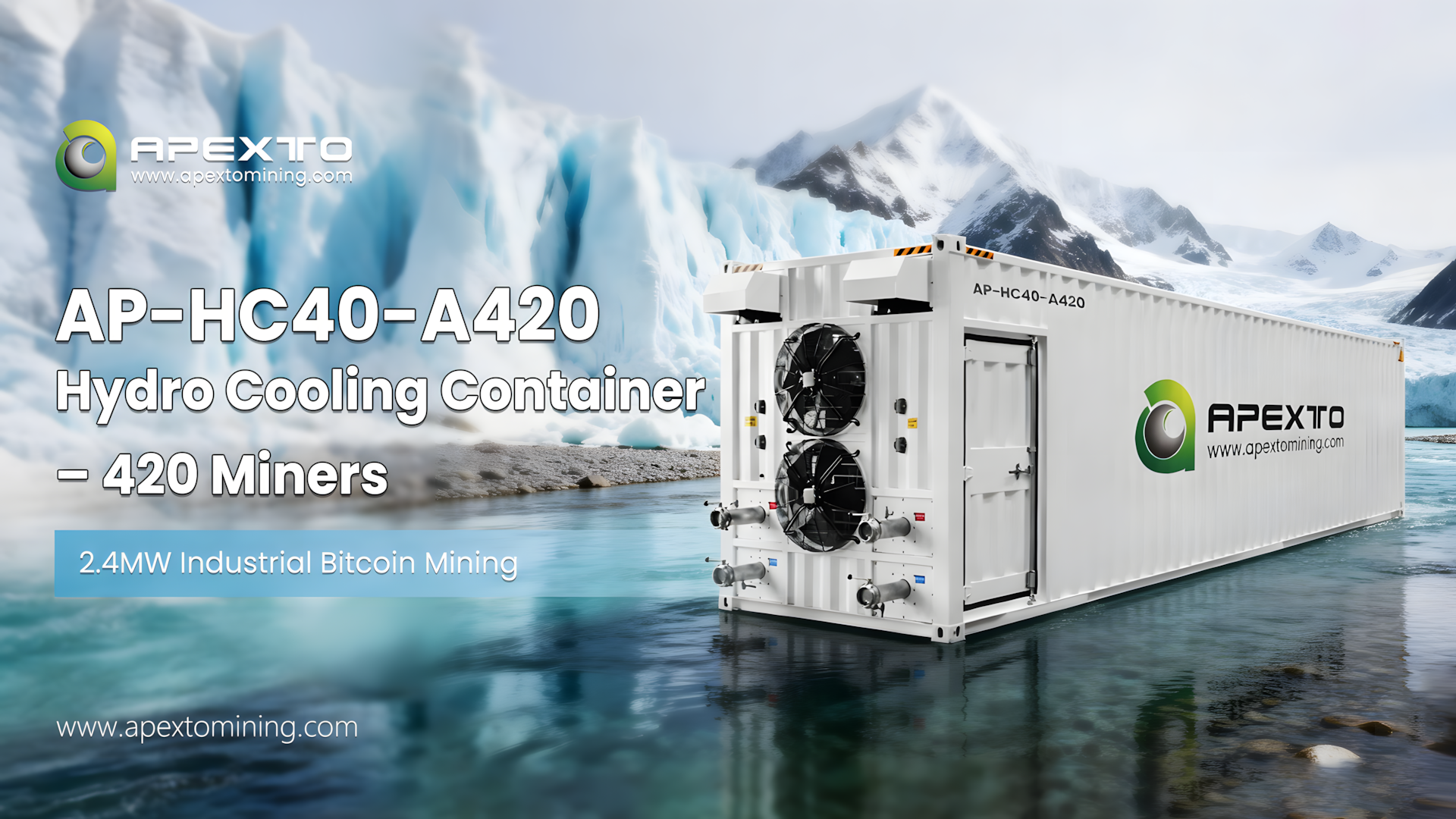
Among these solutions, the AP-HC40-A420 Hydro Cooling Container represents a high-capacity, industrial-grade design built specifically for large-scale, continuous mining environments.
The Infrastructure Challenge Facing Modern Bitcoin Mining
Bitcoin mining has evolved from small, fan-cooled setups into industrial operations operating at megawatt scale. New-generation ASIC miners such as Antminer S19 Hydro, S21 Hydro, and S23 Hydro deliver significantly higher hashrate, but they also generate far more heat per unit.
In real-world mining farms, operators face several recurring challenges:
-
Inconsistent performance due to thermal throttling
-
Increased failure rates during high-temperature seasons
-
Noise, dust, and fan-related maintenance issues
-
Difficulty scaling air-cooled facilities beyond moderate power density
These constraints have accelerated the industry’s transition toward liquid-based cooling systems, particularly containerized hydro cooling solutions.
What Is a Hydro Cooling Container?
A hydro cooling container is a modular mining infrastructure system that integrates ASIC miners, liquid cooling circulation, coolant distribution units (CDUs), power distribution, and monitoring systems within a standard shipping container—typically 40 feet in length.
Instead of relying on ambient airflow, hydro cooling transfers heat directly from the miner’s cold plates into a controlled liquid loop. The heated coolant is then circulated through heat exchangers, allowing precise thermal management regardless of external environmental conditions.
This design enables:
-
Higher miner density per container
-
Stable operating temperatures
-
Reduced mechanical wear
-
Predictable performance across seasons
Why Large-Scale Operators Are Adopting Hydro Cooling Containers
From field deployments and operator feedback, several advantages consistently drive adoption:
Higher Power Density
Hydro cooling containers can support megawatt-level loads within a compact footprint, making them ideal for space-constrained or rapidly expanding sites.
Climate Independence
Unlike air-cooled farms, hydro systems operate reliably in hot, cold, or dusty environments, reducing geographic limitations.
Operational Stability
Consistent coolant temperatures reduce thermal stress on chips, improving uptime and extending hardware lifespan.
Modular Scalability
Containers function as independent units, allowing phased expansion without disrupting existing operations.
Real-World Deployment Case: Industrial-Scale Hydro Cooling Container (2.4 MW)
A commercial Bitcoin mining operator deployed a 40-foot hydro cooling container with a total load approaching 2.4 MW, hosting more than 400 hydro-cooled ASIC miners. The site was located in a region where summer temperatures regularly exceeded the safe operating limits of air-cooled systems.
Deployment Characteristics
-
Rapid on-site installation and commissioning
-
Redundant coolant circulation loops
-
Centralized power distribution with per-miner isolation
-
Remote monitoring of temperature, pressure, and flow rate
Operational Results
The container maintained stable miner inlet temperatures under continuous full-load operation. The operator reported fewer emergency shutdowns, improved hashrate consistency, and reduced maintenance frequency compared to previous air-cooled deployments.
This case reflects a growing industry pattern: hydro cooling containers are not experimental systems—they are operational infrastructure deployed at scale.
Typical Miner Density and Power Planning in AP-HC40-A420
| Miner Type |
Approx. Units per Container |
Estimated Total Power |
Typical Use Case |
| S19 Hydro |
380–420 units |
~2.0–2.4 MW |
Stable large-scale mining |
| S21 Hydro |
350–400 units |
~2.1–2.4 MW |
High efficiency deployment |
| S23 Hydro |
330–380 units |
~2.2–2.4 MW |
Maximum hashrate density |
| Mixed Hydro Fleet |
320–400 units |
~2.0–2.4 MW |
Fleet upgrade / transition |
Multi-Container Mining Parks: A Scalable Architecture
Another widely adopted model involves deploying multiple hydro cooling containers within a single mining park. Each container acts as a self-contained module with independent cooling and monitoring systems.
Benefits Observed in Practice
-
Fault isolation: issues in one container do not affect others
-
Incremental capacity growth aligned with capital planning
-
Simplified maintenance and predictable expansion timelines
For professional mining operators, this architecture reduces risk while preserving flexibility—a critical advantage in volatile market conditions.
Why AP-HC40-A420 Is Designed for Industrial Bitcoin Mining
The AP-HC40-A420 Hydro Cooling Container is engineered specifically for high-density, industrial-scale Bitcoin mining.
Core Design Capabilities
-
Supports up to 420 hydro-cooled ASIC miners
-
Total power capacity of approximately 2.4 MW
-
Dual-loop cooling architecture with redundant pump systems
-
Integrated CDU, leak detection, and intelligent monitoring
In real operational environments, these features allow the AP-HC40-A420 to maintain stable thermal conditions under continuous load, even during peak power demand.
By consolidating cooling, power distribution, and control systems into a single standardized 40-foot container, the AP-HC40-A420 significantly reduces infrastructure complexity and deployment time.
Intelligent Monitoring and Safety Systems
Modern hydro cooling containers are designed with professional operations in mind. The AP-HC40-A420 integrates:
-
Real-time monitoring of coolant temperature and pressure
-
Flow rate and pump performance tracking
-
Leak detection sensors with alarm systems
-
Remote access via PC or mobile interfaces
These systems enable proactive maintenance and rapid response, minimizing downtime and protecting high-value mining hardware.
Performance and Economic Considerations
Although hydro cooling containers typically require higher initial investment than basic air-cooled setups, real-world deployments indicate strong long-term economic benefits:
-
Reduced miner failure rates
-
Improved hardware longevity
-
More stable hashrate output
-
Lower cooling-related energy inefficiencies
Additionally, containerized systems preserve asset flexibility. Units can be relocated, redeployed, or resold as market conditions evolve—an important consideration for professional operators.
Who Should Use the AP-HC40-A420?
The AP-HC40-A420 is well-suited for:
-
Large-scale Bitcoin mining farms
-
High-density hydro-cooled ASIC deployments
-
Operations in hot or variable climates
-
Professional and institutional mining operators
-
Expansion projects requiring rapid deployment
The Future of Bitcoin Mining Infrastructure
As ASIC power density continues to rise, infrastructure decisions will increasingly determine competitive advantage. Hydro cooling containers represent a shift toward standardized, industrial-grade solutions that prioritize efficiency, reliability, and scalability.
Real-world deployments demonstrate that containerized hydro cooling is no longer a niche approach—it is becoming a foundational component of modern Bitcoin mining strategy.