
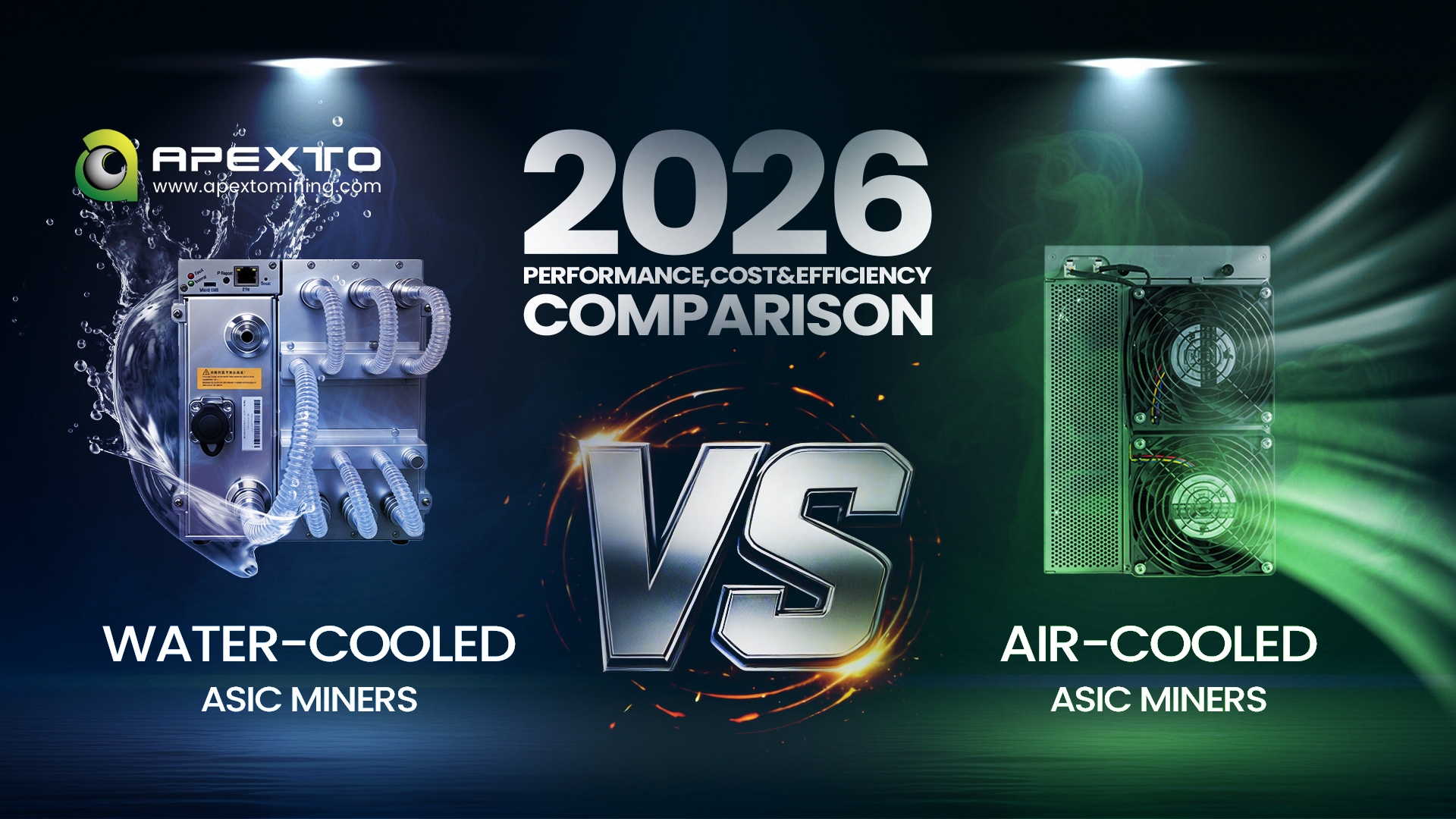
Choosing between water-cooled vs air-cooled ASIC miners is no longer just a technical decision—it’s a strategic business choice that directly affects your mining profitability, operational stability, and long-term ROI.
After the latest Bitcoin halving cycles, margins have tightened significantly. Today, efficiency (J/TH), uptime, and thermal stability matter more than raw hashrate alone. Poor cooling leads to:
- Thermal throttling (lost revenue)
- Increased hardware failure rates
- Higher maintenance costs
- Reduced equipment lifespan
In contrast, optimized cooling—especially hydro cooling mining systems—can unlock:
- Higher sustained hashrate
- Lower electricity cost per TH
- Silent operation (critical for residential setups)
- Longer hardware lifecycle
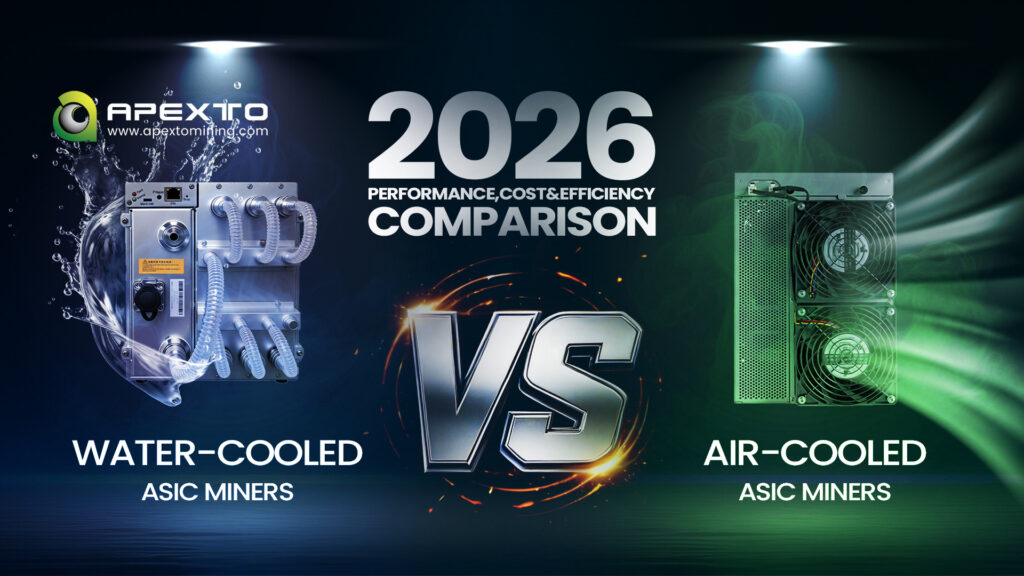
This guide provides a complete ASIC miner cooling comparison, breaking down performance, cost, noise, maintenance, and real-world use cases—so you can choose the best cooling system for your mining operation.
Quick Answer: Water-Cooled vs Air-Cooled ASIC Miners
| Category | Water-Cooled ASIC Miners | Air-Cooled ASIC Miners |
|---|---|---|
| Efficiency | Higher (better heat transfer, lower J/TH) | Moderate (affected by ambient temperature) |
| Scalability | Excellent for large-scale operations | Limited for large deployments |
| Noise Level | Low (38–50 dB, quiet operation) | High (75–82 dB, industrial noise) |
| Best Use Case | Medium to large mining farms | Beginners and small setups |
| Environment Suitability | Performs well in hot climates (30–40°C) | Best in cooler environments |
| Deployment | More complex initial setup | Simple plug-and-play |
| Mobility | Less flexible | Easy to relocate |
Bottom Line
- Choose water-cooled ASIC miners for long-term efficiency, scalability, and low-noise operation.
- Choose air-cooled ASIC miners for simplicity, lower upfront cost, and small-scale mining.
👉 If you plan to scale or operate long-term, water cooling is typically the better investment.
How ASIC Miner Cooling Systems Work
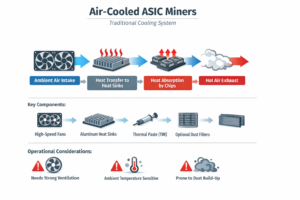
Air-Cooled ASIC Miners (Traditional Design)
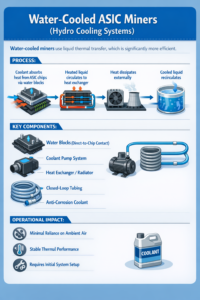
Water-Cooled ASIC Miners (Hydro Cooling Systems)
Water-cooled miners use liquid thermal transfer, which is significantly more efficient.
👉 Related:
Summer Water-Cooled ASIC Miner Maintenance: A Practical Guide for 2026
Performance Comparison: Efficiency, Hashrate & Thermal Stability
ASIC Miner Efficiency Comparison (J/TH)
| Cooling Type | Typical Efficiency | Thermal Stability |
|---|---|---|
| Air-Cooled | 15–20 J/TH | Moderate |
| Water-Cooled | 9.5–16 J/TH | High |
Water cooling improves ASIC miner efficiency by reducing heat-induced resistance and preventing throttling.
Real-World Example: Bitmain S21 Series
| Model | Cooling | Hashrate | Power | Efficiency |
|---|---|---|---|---|
| Antminer S21+ Hydro | Hydro | 395 TH/s | 4785W | 15 J/TH |
| Antminer S21+ | Air | 216 TH/s | 3564W | 16.5 J/TH |
👉 Result:
- +67% higher hashrate
- Better sustained performance under load
Why Water Cooling Performs Better
Water has ~25x higher thermal conductivity than air, leading to:
- Lower chip temperatures
- Uniform heat distribution
- Reduced hotspot formation
- Stable overclocking potential
Noise Comparison: Silent Mining vs Industrial Noise
| Cooling Type | Noise Level | Equivalent |
|---|---|---|
| Air-Cooled | 75–82 dB | Vacuum cleaner |
| Water-Cooled | 38–50 dB | Quiet office |
Why Noise Matters
Home Mining:
- Air-cooled systems are often unusable indoors
- Water-cooled enables garage or indoor deployment
Commercial Mining:
- Lower noise = easier zoning approval
- Better working environment
Urban Mining:
- Water cooling is often the only viable solution
Reliability & Lifespan: Which Lasts Longer?
Air-Cooled Challenges
- Dust accumulation → reduced airflow
- Fan wear → frequent failures
- Thermal cycling → PCB stress
- Humidity exposure
Typical lifespan: 2–4 years
Water-Cooled Advantages
- Sealed environment (no dust ingress)
- No onboard fans
- Stable temperatures
- Lower thermal stress
Typical lifespan: 4–6+ years
👉 In real deployments, hydro systems often extend lifespan by 15–20%
Cost Analysis: Upfront vs Long-Term ROI
Initial Investment
| Category | Air-Cooled | Water-Cooled |
|---|---|---|
| Miner Cost | Lower | Higher |
| Cooling System | Included | Additional |
| Setup Complexity | Low | Medium |
Operational Costs
| Factor | Air-Cooled | Water-Cooled |
|---|---|---|
| Electricity | Higher | Lower |
| Maintenance | Frequent | Reduced |
| Downtime | Higher | Lower |
Hidden Costs (Critical Insight)
Air-cooled miners often lose 10–20% performance in summer, which translates to:
- Lost BTC production
- Reduced ROI
- Longer break-even period
👉 This is rarely accounted for—but highly impactful.
Best Use Cases: Which Should You Choose?
Choose Air-Cooled ASIC Miners If:
- You are a beginner
- Budget is limited
- You run 1–5 miners
- You operate in cold climates
- You need mobility
Choose Water-Cooled ASIC Miners If:
- You run 10+ miners
- You operate in hot regions
- Noise is a concern
- You want long-term ROI
- You plan to scale
Cooling System Infrastructure (Water Cooling)
System Types
1. Integrated Hydro Systems
- Plug-and-play (e.g., S21 Hydro)
- Factory-optimized
2. Custom Cooling Systems
- Retrofit solutions
- Higher flexibility
- Requires expertise
System Sizing Guide
| Miner Count | Recommended Setup |
|---|---|
| 1–15 | Compact cooling cabinet |
| 20–100 | Modular system |
| 200+ | Industrial cooling |
| 500+ | Data-center grade |
Common Misconceptions
“Water cooling is too complex”
→ Modern systems are modular and user-friendly
“Only for large farms”
→ Compact solutions now support home mining
“Leak risk is high”
→ Proper systems have extremely low failure rates
“Air cooling is always cheaper”
→ Not when factoring efficiency and lifespan