Introduction: Bitcoin Mining Enters the ZettaHash Era
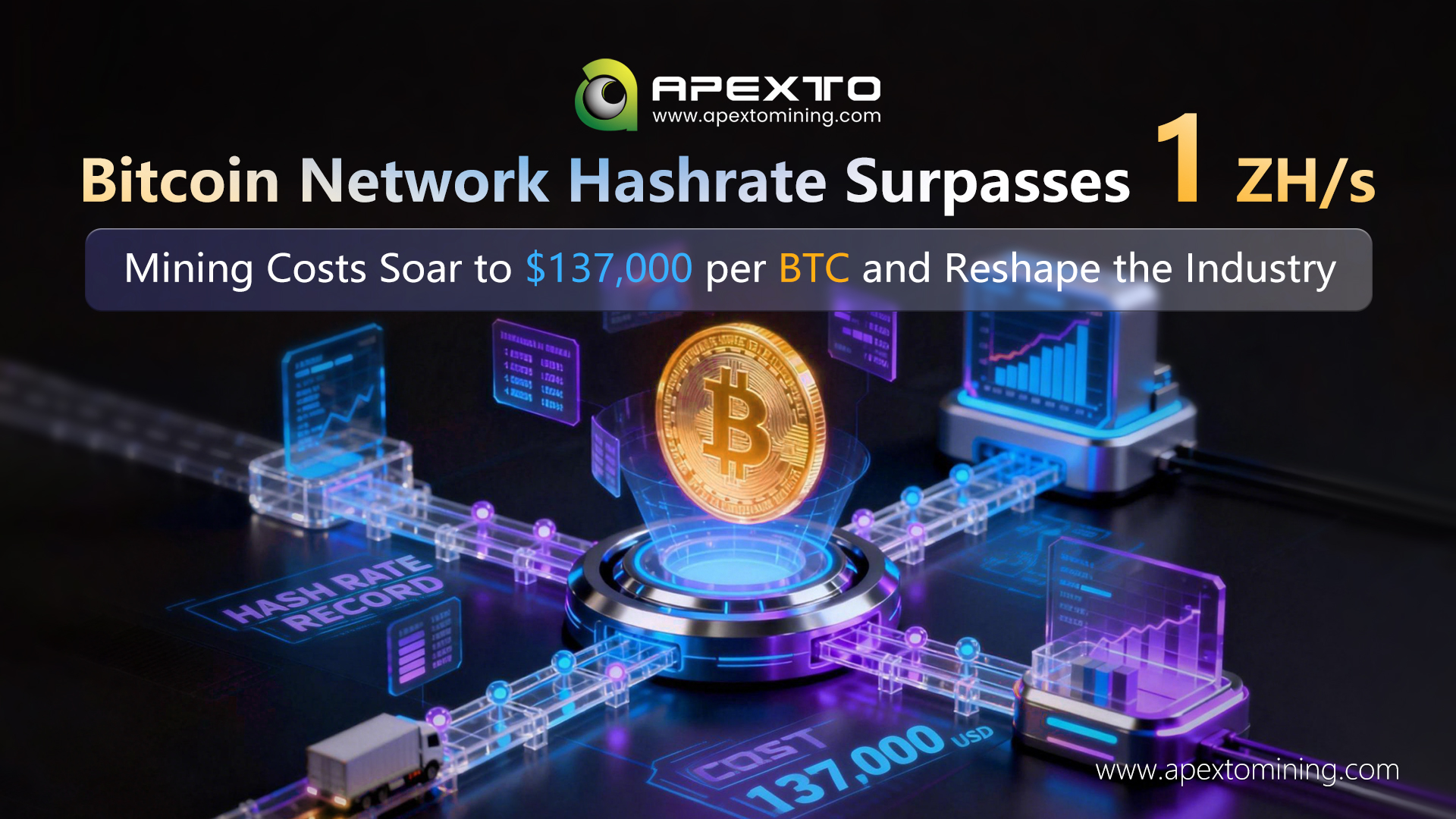
In December 2025, the Bitcoin network crossed a historic and symbolic milestone: Bitcoin Hashrate Hits 1 ZH/s (ZettaHash per second). This achievement represents more than just technological progress—it marks Bitcoin mining’s transition into an era of unprecedented computational intensity, capital concentration, and cost pressure.
According to CryptoRank and public financial disclosures from listed mining companies, the average cash cost to mine one Bitcoin has risen to approximately USD 74,600, while the fully loaded cost—accounting for depreciation and stock-based compensation (SBC)—has surged to nearly USD 137,800 per BTC. At current efficiency levels, hardware payback periods now exceed 1,200 days, placing immense strain on miners’ balance sheets.
This article analyzes why Bitcoin mining costs have exploded, how 1 ZH/s fundamentally changes mining economics, and what this means for miners, investors, and hardware buyers in 2026 and beyond.
Understanding the 1 ZH/s Milestone
What Does 1 ZettaHash Mean?
A ZettaHash equals 1,000 ExaHashes, or one sextillion hashes per second. When Bitcoin launched in 2009, the network measured its hashrate in kilohashes. Crossing 1 ZH/s represents a 15-order-of-magnitude increase in computational power over Bitcoin’s lifetime.
This milestone reflects:
-
Massive global deployment of next-generation ASIC miners
-
Increased participation by publicly listed mining corporations
-
Institutional capital inflows following Bitcoin ETF approvals
-
Aggressive reinvestment cycles driven by competitive pressure
While impressive, this growth has a direct consequence: only the most efficient operators survive.
Mining Difficulty and Cost Escalation
Difficulty Adjustment at Extreme Levels
Bitcoin’s mining difficulty adjusts every ~2,016 blocks to maintain a 10-minute block interval. With hashrate surpassing 1 ZH/s, difficulty has reached all-time highs, sharply reducing BTC output per terahash.
As a result:
-
Each additional TH/s generates less Bitcoin than ever before
-
Revenue predictability declines
-
Capital efficiency becomes critical
Rising Cost Structure Breakdown
Based on aggregated data from North American and Asian public miners:
| Cost Category |
Approx. Contribution |
| Electricity |
$35,000–$45,000 |
| Hardware depreciation |
$40,000–$50,000 |
| Hosting & O&M |
$10,000–$15,000 |
| Labor & administration |
$5,000–$8,000 |
| SBC & financing |
$10,000–$20,000 |
Total all-in cost: ~$137,000 per BTC
Even miners operating below $0.04/kWh electricity rates are struggling to maintain positive margins under these conditions.
The End of the Small and Mid-Size Miner Era
Extended ROI Cycles
In previous market cycles, efficient miners achieved ROI within 300–500 days. In the ZH/s era, ROI now exceeds 1,200 days, even under optimistic assumptions.
This has led to:
-
Shutdown of home and garage mining
-
Liquidation of mid-sized hosting operators
-
Forced asset sales during market downturns
Capital Intensity Becomes the Barrier
Modern Bitcoin mining now requires:
-
Bulk ASIC procurement agreements
-
Long-term energy contracts
-
Sophisticated treasury management
-
Access to low-cost capital markets
This environment systematically excludes undercapitalized participants.
Public Miners at Breakeven: A Structural Shift
Margins Collapse Even for Industry Leaders
Financial disclosures show that even top-tier miners—operating cutting-edge fleets and sub-$0.035/kWh energy—are hovering near cash-flow breakeven.
Key pressures include:
-
Rapid ASIC obsolescence
-
Rising interest rates on infrastructure debt
-
Dilution from equity financing
-
Increasing maintenance complexity at scale
Mining has transitioned from a high-margin growth business to a low-margin infrastructure operation.
Why Mining Companies Are Pivoting to AI and HPC
Synergy Between Mining and AI Infrastructure
Facing declining mining margins, large operators are repurposing infrastructure for:
Bitcoin miners already possess:
These assets are increasingly valuable in the AI economy.
Strategic Diversification Trends
Leading mining companies are now:
-
Converting immersion-cooled sites to GPU clusters
-
Signing long-term AI compute contracts
-
Using BTC mining as a baseline load rather than primary revenue
This trend further reduces competition for mining rewards—but also signals a mature, capital-heavy industry.
Implications for Bitcoin Mining Hardware Buyers
Efficiency Is No Longer Optional
In a 1 ZH/s network, hardware efficiency is the primary determinant of survival. Buyers must prioritize:
-
J/TH efficiency over raw hashrate
-
Thermal stability for long runtimes
-
Compatibility with immersion or hydro cooling
-
Manufacturer reliability and warranty support
New vs. Used Miners
| Option |
Pros |
Cons |
| New-generation ASICs |
Best efficiency, longer lifecycle |
High upfront cost |
| Used miners |
Lower entry cost |
Short ROI window, higher failure risk |
For professional operators, new-generation miners are increasingly mandatory.
Energy Strategy: The Deciding Factor
Electricity now represents the single largest variable cost.
Winning strategies include:
-
Co-locating with stranded or curtailed energy
-
Flexible load participation with grids
-
On-site generation (hydro, flare gas, nuclear-adjacent)
-
Long-term fixed-price PPAs
Without a sub-$0.04/kWh energy strategy, mining profitability becomes speculative.
Long-Term Outlook: What Comes After 1 ZH/s?
Hashrate Will Continue to Grow—But Slower
While 1 ZH/s is a major milestone, growth rates are expected to moderate due to:
Bitcoin Price Becomes the Only Relief Valve
Ultimately, sustained mining profitability at current cost levels requires:
-
Higher long-term BTC prices
-
Reduced issuance post-halving
-
Increased transaction fee revenue
Mining is increasingly a leveraged bet on Bitcoin’s macro adoption rather than a standalone profit engine.
Conclusion: Bitcoin Mining Has Become Industrial Infrastructure
The Bitcoin network crossing 1 ZH/s represents both triumph and transformation. Mining has evolved from a distributed grassroots activity into a highly industrialized, capital-intensive infrastructure sector.
With full mining costs approaching $137,000 per BTC, only operators with:
will remain competitive.
For hardware buyers, investors, and mining professionals, the message is clear: the ZettaHash era rewards discipline, scale, and long-term strategy—nothing else.