
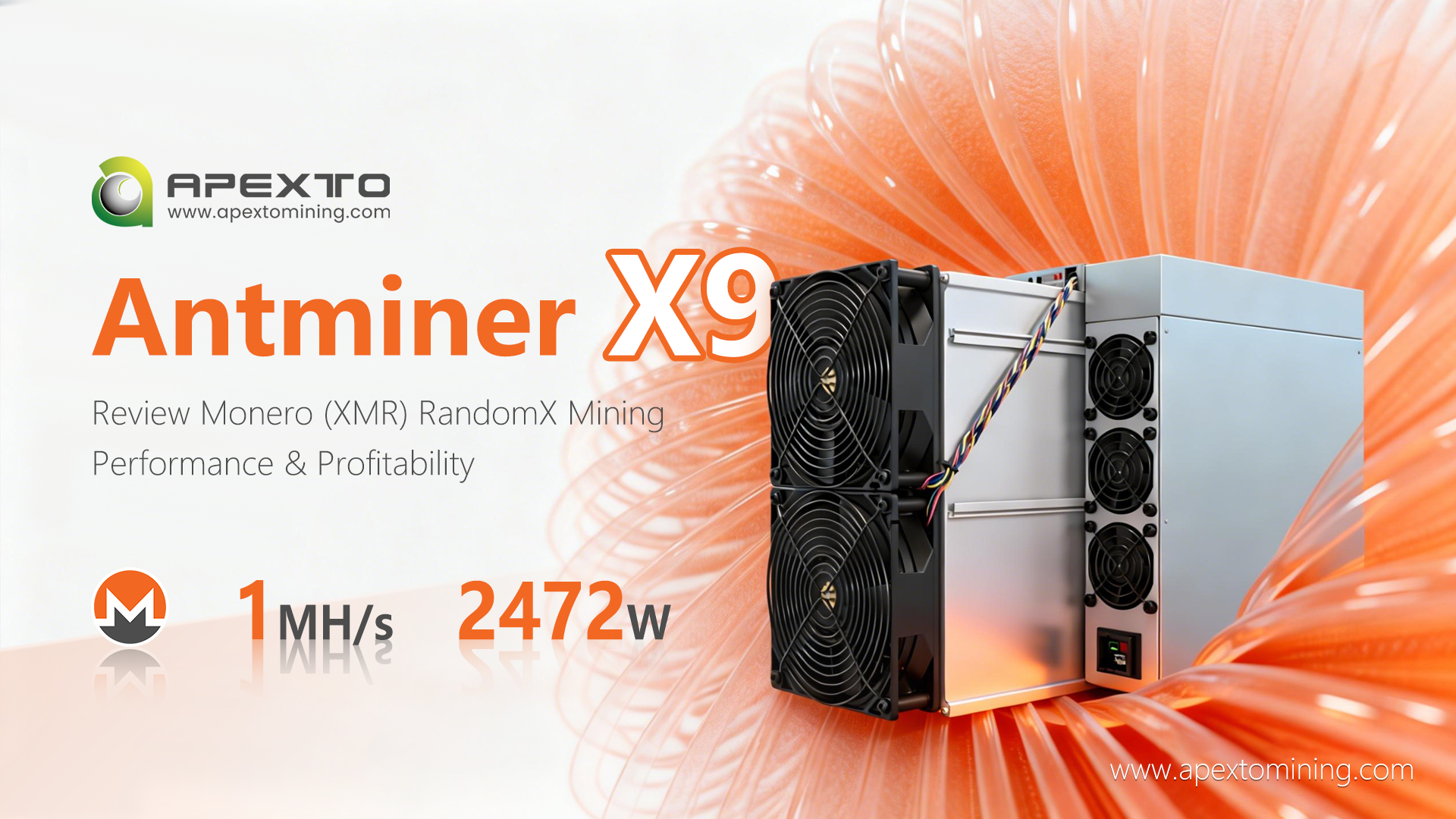
As Monero (XMR) mining continues to evolve under the RandomX algorithm, miners are increasingly evaluating whether specialized hardware can outperform traditional CPU-based setups in both performance and long-term profitability. The Antminer X9, developed by Bitmain, is one of the most powerful RandomX ASIC miners available, specifically designed for professional XMR mining operations.
This review focuses on RandomX mining performance, energy efficiency, technical evolution (vs Antminer X5), operational traits, and profitability analysis of the Antminer X9.
Antminer X9 Overview
The Antminer X9 is a dedicated RandomX ASIC miner optimized for Monero (XMR). Unlike CPUs or GPUs, which rely on general-purpose processing, the X9 integrates custom silicon tailored to RandomX workloads, enabling significantly higher hashrate density and improved power efficiency.

Antminer X9 XMR Miner
Key Specifications
-
Manufacturer: Bitmain
-
Model: Antminer X9
-
Algorithm: RandomX
-
Mineable Coin: Monero (XMR)
-
Hashrate: ~1,000 KH/s (1 MH/s)
-
Power Consumption: ~2472 W
-
Energy Efficiency: ~2.47 J/KH
-
Cooling: Dual high-speed fans
-
Noise Level: ~75–76 dB
-
Network Interface: Ethernet (RJ-45)
These specifications translate into a data-center friendly device capable of running at high utilization with predictable output.
RandomX Mining Performance
Hashrate and Raw Output
A hashrate of ~1 MH/s positions the Antminer X9 significantly above traditional mining hardware in the Monero ecosystem:
-
High-end CPU: ~10–20 KH/s
-
GPU rigs: ~40–70 KH/s
-
Antminer X9: ~1,000 KH/s
This consolidation allows operators to replace dozens of CPUs with a single X9 unit, reducing rack space, cabling complexity, and support overhead.
Stability and Consistency
As an ASIC platform, the X9 delivers:
-
Stable hashrate over long periods
-
Predictable operating temperature
-
Integrated ASIC firmware monitoring
This stands in contrast to CPU mining, where results may fluctuate based on OS load and thermal throttling.
Technical Evolution: Antminer X9 vs Antminer X5
Understanding the Antminer X9’s place in the RandomX hardware landscape requires a comparison to its predecessor, the Antminer X5.
Antminer X5: The First-Generation RandomX ASIC
The Antminer X5 was Bitmain’s initial attempt to bring ASIC-level optimization to the RandomX algorithm. While technically capable, the X5’s performance and efficiency remained closer to high-end CPU clusters than to a dedicated mining ASIC:
-
Lower hashrate density compared to X9
-
Relatively high energy cost per hash
-
Served more as proof of concept for ASIC viability on RandomX
The X5 demonstrated that RandomX could be targeted by specialized silicon, but its architectures and firmware were still in the early stages of optimization.
Antminer X9: A Refined, Production-Ready Design
The Antminer X9 represents a substantial technical advancement over the X5:
| Feature | Antminer X5 | Antminer X9 |
|---|---|---|
| Hashrate | Lower | ~1 MH/s |
| Power Efficiency | Moderate | ~2.47 J/KH |
| Compute Density | Low | High |
| Operational Stability | Experimental | Production-capable |
| Firmware Maturity | Early | Refined |
| Scalability | Limited | High |
Key improvements in the X9 include:
-
Substantially higher hashrate, minimizing unit count per farm
-
Lower energy cost per hash, improving long-term profitability
-
Mature firmware and monitoring tools, reducing manual tuning
-
Better memory access handling, critical under RandomX workloads
In effect, the X9 transitions RandomX ASIC mining from an experimental niche into a scalable and efficient production-grade solution.
Power Consumption and Efficiency
Although the Antminer X9 draws ~2472 W, its performance efficiency is where the device excels.
Efficiency Comparison
| Hardware | Hashrate | Power | Efficiency |
|---|---|---|---|
| High-end CPU | ~15 KH/s | 150 W | ~10 J/KH |
| GPU Rig | ~60 KH/s | 800 W | ~13 J/KH |
| Antminer X9 | 1000 KH/s | 2472 W | 2.47 J/KH |
The X9’s energy cost per kilohash is a substantial improvement over CPU or GPU-based mining, making it compelling when electricity costs are competitively low.
Profitability Analysis

Key Profitability Variables
-
Network difficulty and XMR block reward
-
Monero (XMR) market price
-
Electricity cost (kWh rate)
-
Pool fees
-
Hardware acquisition cost
Under typical industrial electricity rates (below $0.06–$0.08/kWh), the Antminer X9 can deliver higher daily yields than comparable CPU mining clusters, both in net output and operational simplicity.
ROI Considerations
While the upfront cost of an X9 unit may exceed that of comparable CPU fleets, advantages include:
-
Lower administrative overhead
-
Reduced failure rates
-
Centralized firmware dashboards
-
Lower cumulative energy cost
For professional miners, ROI is more closely tied to operational efficiency than raw hardware cost.
Cooling, Noise, and Deployment
The Antminer X9’s noise and thermal output reflect its industrial orientation:
-
Noise level: ~75 dB
-
Cooling: Dual high-speed fans and dense heatsinks
This makes the unit unsuitable for typical residential settings. Ideal deployment scenarios include:
-
Dedicated mining farms
-
Server rooms with industrial cooling
-
Containerized or rack-based deployments
Adequate power infrastructure (220–240V) is required for stable operation.
Antminer X9 vs CPU Mining for Monero
Advantages of the X9
-
Vastly superior hashrate per unit
-
Greatly improved energy efficiency
-
Simplified deployment and monitoring
-
Consolidated hardware footprint
Trade-Offs
-
Solely optimized for RandomX
-
Higher initial capital investment
-
Exposure to potential algorithm changes
For miners committed to Monero, these trade-offs are typically acceptable in exchange for long-term operational efficiency.
Long-Term Viability and Algorithm Risk
RandomX was designed to resist wholesale ASIC centralization, not ASIC development entirely. High-cost, low-volume ASICs like the Antminer X9 fall within an economic niche that Monero’s governance currently tolerates.
Monero’s stable emission schedule and strong community support further mitigate governance risk, making the X9 a viable long-term mining option rather than a short-lived experiment.
Final Verdict: Performance & Profitability
The Antminer X9 delivers best-in-class RandomX mining performance and excellent energy efficiency, positioning it as one of the most capable Monero mining ASICs available today. While it is not aimed at casual or home miners, the X9 offers compelling value for operators with professional infrastructure and low electricity costs.
Summary of key strengths:
-
Exceptional RandomX hashrate and density
-
Superior energy efficiency versus CPUs and GPUs
-
Mature operational software and monitoring
-
Significant improvement over Antminer X5
For miners committed to the Monero ecosystem, the Antminer X9 represents a performance and profitability upgrade that is both technically and economically defensible.