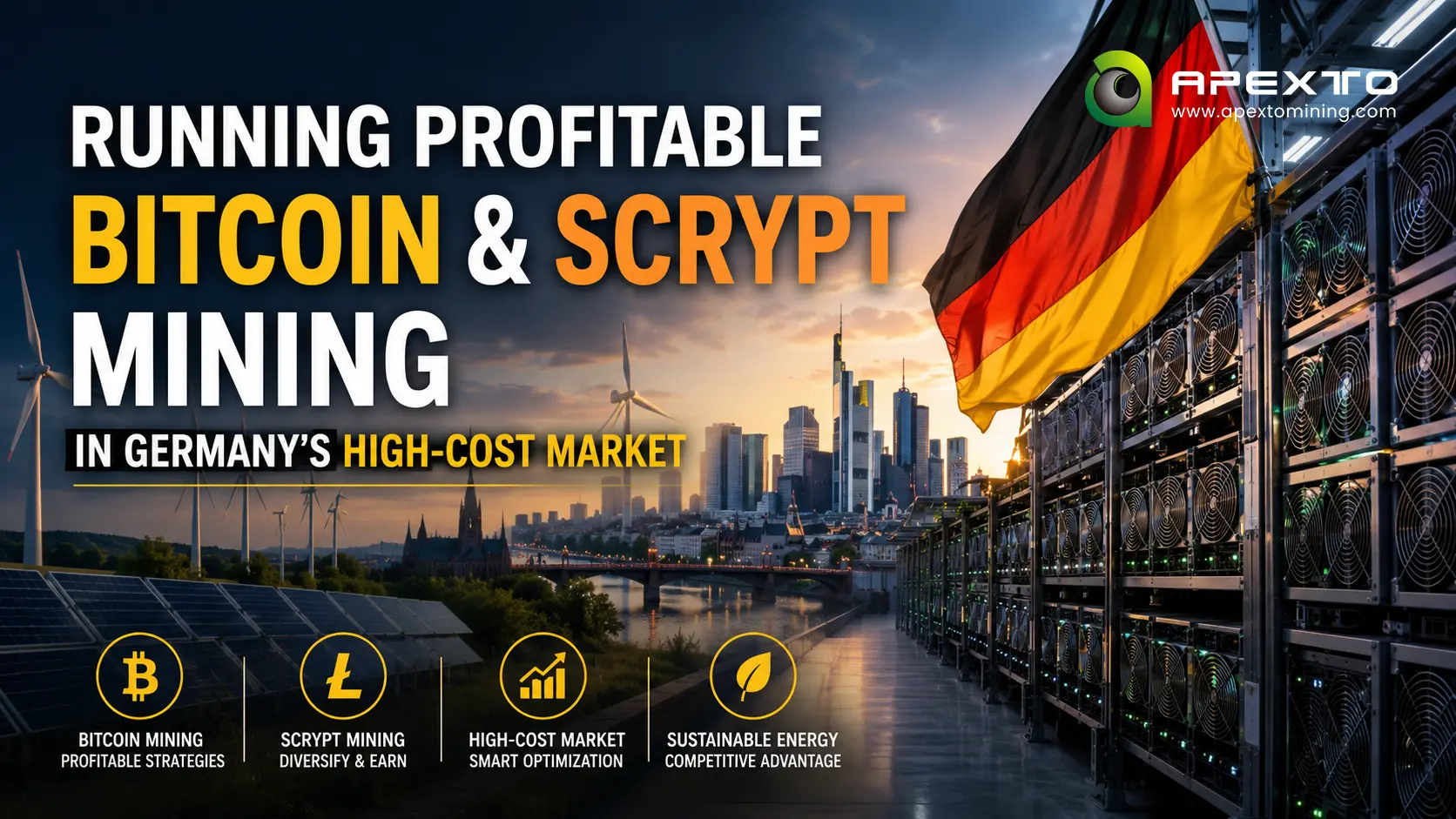
2026 Hardware Survival Guide: Running Profitable Bitcoin & Scrypt Mining in Germany’s High-Cost Market
Why “Best Hardware” Is a Myth in Germany
Germany doesn’t have “expensive electricity.” It has industrial-grade cost discipline. The average industrial tariff is €0.24–€0.31/kWh (EUROSTAT Q4 2024), but mining-specific contracts demand proof of load management, grid stability contributions, and strict thermal compliance (DIN EN 62305 + VDE 0100-551). In this environment, raw hash rate is irrelevant. What matters is:
- Joules per Terahash (J/TH) — your true energy tax;
- Heat density (W/cm²) — determines if your host accepts you;
- Acoustic output (dB(A)) — governs facility zoning;
- Firmware flexibility — enables dynamic frequency scaling during peak grid stress.
This guide cuts through marketing noise. These are the 4 Antminers that pass the German P&L test — not in theory, but in practice.
The 3 Survival Rules for German Miners (2026 Edition)
1. Energy Arbitrage > Hash Rate Chasing
Don’t chase TH/s. Chase time-of-use arbitrage. Germany’s day-ahead market (EPEX SPOT) shows €0.12–€0.42/kWh swings. Your hardware must support rapid frequency scaling (±30% in <5 sec) to align with price dips. Static overclocking = guaranteed loss.
2. Hardware Tiering by Thermal Envelope
Your host won’t tell you their airflow limit — until your S21 Pro trips their thermal sensor. Tier hardware by heat flux, not algorithm:
- Tier A (≤ 1.8 W/cm²): S21 XP, Z15 Pro → fits standard air-cooled racks;
- Tier B (1.9–2.7 W/cm²): S21 Pro+, L9 → requires dedicated ducting or immersion;
- Tier C (>2.7 W/cm²): Not recommended for DE hosting without pre-approved liquid loop.
3. Hosting as Infrastructure — Not a Commodity
German hosting isn’t “rent space, plug in.” It’s an SLA-backed infrastructure service: 99.95% uptime, real-time thermal telemetry, automated grid-response firmware updates, and VAT-compliant billing. Choose hosts that publish their own energy sourcing (e.g., 100% hydro/wind) — it unlocks lower tariffs.
Antminer Deep Dive: Real-World Performance in DE Conditions
| Model | Algorithm | Hash Rate | Efficiency (J/TH) | Heat Density | Noise (dB(A)) | Key German Use Case |
|---|---|---|---|---|---|---|
| Antminer S21 XP | SHA-256 | 200 TH/s | 19.5 J/TH | 1.6 W/cm² | 72 dB(A) | Primary BTC workhorse for air-cooled co-location (e.g., Frankfurt). Lowest J/TH in class → highest margin at €0.22/kWh. Requires Bitmain firmware v1.0.8+ for EPEX SPOT integration. |
| Antminer S21 Pro+ | SHA-256 | 234 TH/s | 23.5 J/TH | 2.4 W/cm² | 78 dB(A) | Niche use only: paired with on-site solar + battery buffer (e.g., Bavaria farms). Higher heat density demands custom ducting — adds €1,200/hosting setup fee. |
| Antminer L9 | Scrypt | 11.5 GH/s | 24.5 J/MH | 2.1 W/cm² | 75 dB(A) | Scrypt survival tool: targets VerusCoin (VRSC) & Einsteinium (EMC2) where network difficulty remains stable. Avoids BTC’s volatility while leveraging existing DE hosting contracts. |
| Antminer Z15 Pro | Equihash | 1.2 MH/s | 8.5 J/kH | 1.3 W/cm² | 68 dB(A) | Low-noise, low-heat Equihash option for urban edge hosting (e.g., Berlin server closets). Highest efficiency per watt in its class — ideal for “green tariff” add-ons. |
💡 Critical Note on Firmware: All four models require Bitmain’s Germany-Specific Firmware Pack (v1.0.5+), which enforces automatic shutdown during grid frequency deviations > ±0.2 Hz — a legal requirement under §13 EnWG. Default firmware will be rejected by DE hosts.
Scenario-Based Recommendations
- You’re leasing rack space in Hamburg (air-cooled, max 2.0 W/cm², 75 dB(A) limit): → S21 XP only. Its 1.6 W/cm² and 72 dB(A) fit cleanly. S21 Pro exceeds both limits.
- You operate a solar-powered farm in Brandenburg (2MW PV, battery buffer, full thermal control): → S21 Pro+ + L9 stack. Use S21 Pro during midday surplus; shift L9 to night when Scrypt network rewards spike.
- You run a small-scale urban operation in Munich (server closet, noise-sensitive neighbors, no ducting): → Z15 Pro only. Its 68 dB(A) and 1.3 W/cm² meet all municipal codes. Avoid L9/S21 series entirely.
Final Word: Hardware Is Your First Cost-Control Lever
In Germany, your Antminer isn’t a tool — it’s your most granular cost-control instrument. Choosing S21 XP over S21 Pro isn’t about “more hash.” It’s about reducing your energy tax by 17% (19.5 vs 23.5 J/TH), staying within thermal SLAs, and avoiding €1,200 in forced ducting fees.
About Ada
I am a Data Analyst at Apexto Mining, with experience in the cryptocurrency mining industry since 2017. My work focuses on analyzing ASIC performance, thermal efficiency, and mining profitability, especially in hydro and immersion cooling environments. I contribute to technical research and content creation, including blog articles and educational materials on mining hardware and infrastructure optimization. I also work closely with engineering and sales teams to translate technical data into practical insights for customers and partners. I believe mining technology should be communicated clearly and transparently, supported by real data and measurable performance. Outside of work, I enjoy yoga, reading, and traveling.
View all posts by AdaRelated posts
2026 Hardware Survival Guide: Running Profitable Bitcoin & Scrypt Mining in Germany’s High-Cost Market
Bitcoin Mining Outlook 2026: Seven Strategic Shifts Reshaping the Industry
What Is Nexa?
Blockchain vs Cryptocurrency: The Fundamental Difference Every Miner Needs to Understand
The Strategic Guide to Altcoin Mining in 2026: Beyond Bitcoin
Bitcoin Mining Software: The Complete Beginner’s Guide to Choosing and Using Mining Tools in 2026
Search Blog
Recent Posts
For media inquiries, please contact
info@apexto.com.cn