Quick Verdict: What’s the Real Difference?
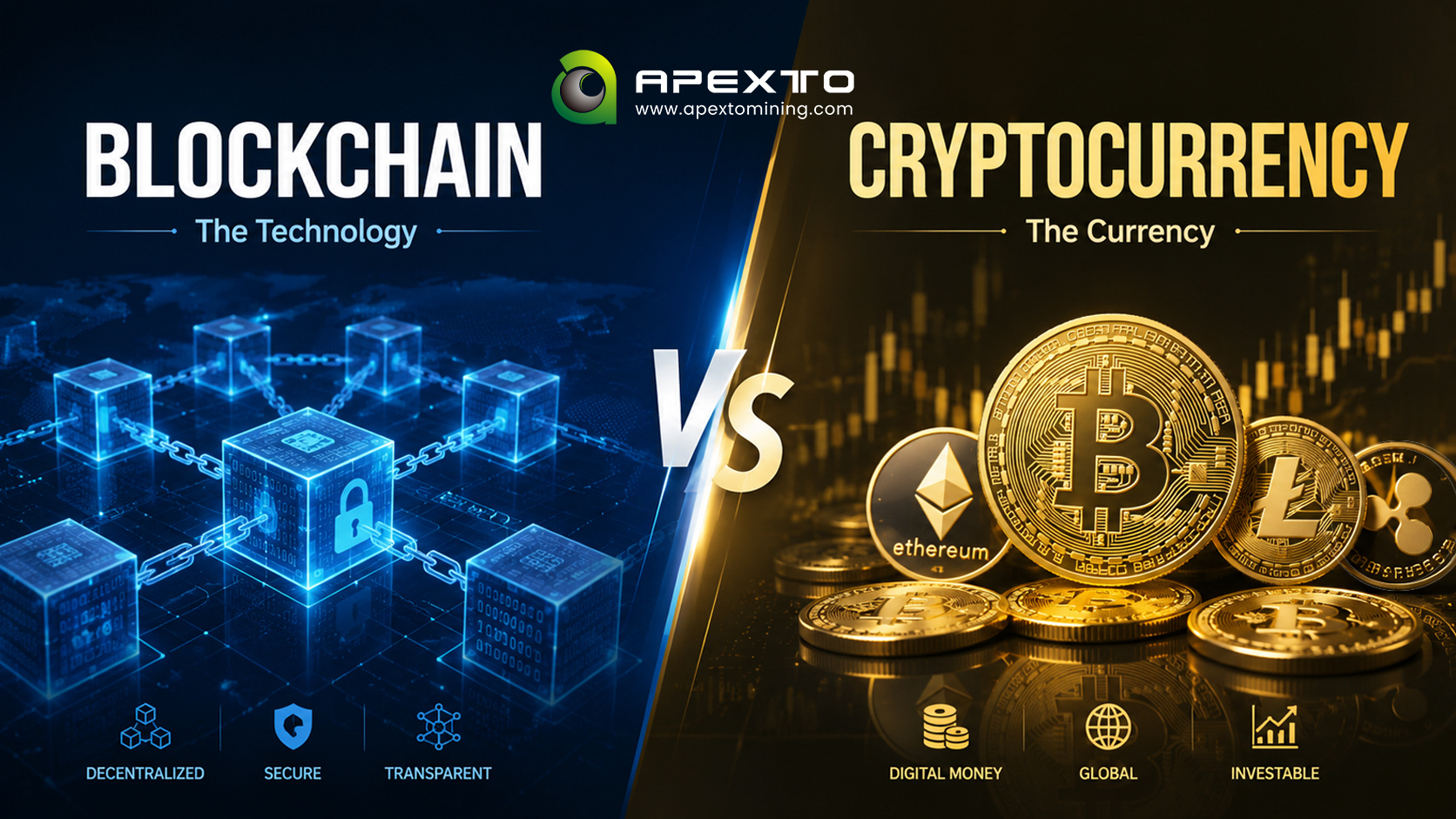
Short answer: Blockchain is the infrastructure (like roads and traffic rules), while cryptocurrency is the asset that moves on it (like cars and trucks). You can have blockchain without cryptocurrency, but you cannot have cryptocurrency without blockchain.
For miners: Understanding this distinction explains why ASIC efficiency matters more than token price volatility, why enterprise blockchain adoption creates new mining opportunities beyond Bitcoin, and why “blockchain companies” aren’t necessarily crypto companies.
Bottom line: Blockchain is the engine; cryptocurrency is the fuel. Both matter, but they solve different problems.
Quick Facts: Blockchain vs Cryptocurrency — Key Metrics
| Feature |
Blockchain |
Cryptocurrency |
| Definition |
Distributed ledger technology |
Digital asset built on blockchain |
| Primary function |
Record-keeping & verification |
Store of value & medium of exchange |
| Examples |
Ethereum, Hyperledger Fabric, Corda |
Bitcoin, Ethereum (ETH), Solana (SOL) |
| Mining relevance |
Proof-of-Work blockchains require mining |
Most cryptocurrencies use blockchain for validation |
| Energy consumption |
Varies by consensus (PoW > PoS > PBFT) |
Determined by underlying blockchain |
| Market cap (2026) |
$0 (infrastructure, not traded) |
$3.2T (global crypto market cap) |
| Regulatory status |
Generally unregulated as tech |
Heavily regulated as financial assets |
Part 1: Blockchain — The Foundation Layer
What Is Blockchain, Really?
Blockchain is a distributed database that maintains a continuously growing list of records called blocks. Each block contains:
- A timestamp
- Transaction data
- A cryptographic hash of the previous block
- A consensus mechanism (Proof-of-Work, Proof-of-Stake, etc.)
Think of it as a digital notary service that’s decentralized, immutable, and transparent.
Why Miners Care About Blockchain
As a miner, you’re not just mining coins — you’re securing the blockchain infrastructure. Your ASICs perform the computational work that:
- Validates transactions
- Creates new blocks
- Maintains network security
- Prevents double-spending
The blockchain is what makes cryptocurrency possible. Without it, digital money would be vulnerable to fraud and central control.
Real-World Blockchain Use Cases Beyond Crypto
While Bitcoin popularized blockchain, the technology has exploded into enterprise applications:
- Supply chain tracking: Maersk and IBM’s TradeLens uses blockchain to track shipping containers globally
- Healthcare records: Estonia’s e-Health system stores 99% of health records on blockchain
- Voting systems: West Virginia piloted blockchain voting for overseas military personnel in 2024
- Intellectual property: Artists use NFT blockchains to prove ownership of digital art
These applications don’t require cryptocurrency — they use blockchain’s core strengths: immutability, transparency, and decentralization.
Part 2: Cryptocurrency — The Digital Asset
What Is Cryptocurrency?
Cryptocurrency is a digital or virtual currency that uses cryptography for security and operates independently of a central bank. It’s built on top of blockchain technology.
Cryptocurrencies serve three primary functions:
- Medium of exchange (Bitcoin for payments)
- Store of value (Bitcoin as “digital gold”)
- Utility token (Ethereum’s ETH for smart contract execution)
Why Miners Care About Cryptocurrency
Cryptocurrency is your revenue stream. The coins you mine represent:
- Immediate cash flow (when sold)
- Long-term value appreciation (when held)
- Network security incentives (rewards for maintaining blockchain)
However, cryptocurrency prices are volatile because they’re driven by market forces (supply/demand, investor sentiment, regulatory news), while blockchain performance is driven by technical factors (hashrate, difficulty, energy efficiency).
Cryptocurrency vs Traditional Finance
| Comparison |
Cryptocurrency |
Traditional Currency |
| Issuance |
Algorithmic (mining/staking) |
Central bank policy |
| Transaction speed |
10 sec – 10 min (varies by chain) |
Instant (credit cards) / 1-3 days (bank transfers) |
| Fees |
$0.01 – $50 (network congestion dependent) |
$0.25 – $35 (intermediary fees) |
| Cross-border |
Native (no intermediaries) |
Requires correspondent banks |
| Accessibility |
Anyone with internet access |
Bank account required |
Part 3: The Critical Relationship — Why Confusing Them Hurts Miners
Common Misconceptions That Cost Money
Myth 1: “Blockchain will replace banks, so crypto prices will always rise” Reality: Enterprise blockchain adoption (like JPMorgan’s JPM Coin) often uses private, permissioned blockchains without cryptocurrency. This doesn’t drive BTC demand.
Myth 2: “More blockchain projects = more mining opportunities” Reality: Only Proof-of-Work blockchains require mining. Most enterprise blockchains use consensus mechanisms that don’t need ASICs.
Myth 3: “Cryptocurrency price crashes mean blockchain is failing” Reality: Blockchain adoption continues regardless of crypto prices. In Q1 2026, enterprise blockchain spending grew 28% YoY while crypto markets were flat.
The Data: What 2026 Numbers Tell Us
- Blockchain adoption growth (2026): +28% YoY (Gartner)
- Cryptocurrency market cap change (2026 YTD): +12% (CoinGecko)
- Enterprise blockchain spending (2026): $18.4B (Statista)
- ASIC efficiency improvement (2026): +37% YoY (Bitmain, MicroBT reports)
- Number of PoW blockchains requiring mining: 12 (down from 24 in 2022)
The takeaway: Blockchain is maturing as infrastructure, while cryptocurrency remains volatile as an asset class. As a miner, focus on the infrastructure layer — that’s where your hardware expertise delivers consistent value.
Part 4: Practical Implications for Apexto Mining Operations
How This Knowledge Improves Your Bottom Line
- Hardware selection: Prioritize ASICs optimized for specific blockchains (BTC, LTC, DOGE) rather than chasing “hot” cryptocurrencies
- Energy strategy: Blockchain’s energy demands are predictable; cryptocurrency price volatility isn’t. Lock in power contracts based on hash rate, not coin price
- Diversification: Consider mining multiple PoW blockchains to spread risk across different network fundamentals
- Future-proofing: Monitor enterprise blockchain adoption — new PoW chains may emerge from industrial applications
Actionable Recommendations
✅ Do: Track blockchain network metrics (hashrate, difficulty, transaction volume) alongside cryptocurrency prices ✅ Do: Analyze electricity costs per TH/s rather than per coin mined ✅ Do: Monitor enterprise blockchain adoption in mining-relevant sectors (energy, logistics, finance) ❌ Don’t: Assume every “blockchain company” announcement means new mining opportunities ❌ Don’t: Let cryptocurrency price swings distract from core mining efficiency metrics ❌ Don’t: Over-invest in hardware for low-difficulty, low-value cryptocurrencies without sustainable economics
Conclusion: Two Sides of the Same Digital Revolution
Blockchain and cryptocurrency are inseparable but fundamentally different. Blockchain is the technological foundation — reliable, measurable, and increasingly adopted across industries. Cryptocurrency is the economic expression — volatile, speculative, and subject to market forces.
For Apexto Mining, this means focusing on what we control: hardware efficiency, energy optimization, and operational excellence. The blockchain infrastructure will continue evolving regardless of cryptocurrency price cycles. Our job is to secure that infrastructure profitably.
Final thought: In 2026, the most successful miners aren’t those chasing the highest coin prices — they’re those who understand the underlying blockchain mechanics better than anyone else.
About Apexto Mining: We specialize in high-efficiency Bitcoin mining operations with a focus on sustainable energy solutions and cutting-edge hardware optimization. Follow us on YouTuBe (@ApextoMining) for real-time mining insights and hardware efficiency benchmarks.
 Bitmain Antminer
 IceRiver
 Whatsminer
 Canaan Avalon
 Goldshell
 Solo Miner
 Elphapex
 Volcminer
 Jasminer
 Pinecone
 Bitcoin
 Dogecoin
 Aleo
Aleo
 Kaspa
Kaspa
 ALPH
ALPH
 Nexa
Nexa
 ETC
ETC
 CKB
CKB
 Dash
Dash
 Kadena