Bitmain Antminer
 IceRiver
 Whatsminer
 Canaan Avalon
 Goldshell
 Solo Miner
 Elphapex
 Volcminer
 Jasminer
 Pinecone
 Bitcoin
 Dogecoin
 Aleo
Aleo
 Kaspa
Kaspa
 ALPH
ALPH
 Nexa
Nexa
 ETC
ETC
 CKB
CKB
 Dash
Dash
 Kadena










Introduction
Bitcoin, introduced in 2009, is the first cryptocurrency and remains the most significant player in the crypto world. It laid the foundation for a new era of digital currency by introducing blockchain technology, which enables decentralized, secure, and transparent transactions. As the pioneer of decentralized finance, Bitcoin not only revolutionized how people perceive money but also set the stage for the development of other cryptocurrencies. In this article, we will explore the origins of Bitcoin, how it works, its impact on the cryptocurrency market, and what the future might hold for this groundbreaking technology.
The Origin of Bitcoin
Bitcoin was created in 2009 by an anonymous figure or group known as Satoshi Nakamoto. The idea was to develop a decentralized digital currency that would operate independently of any central authority, such as governments or banks. At the core of Bitcoin’s innovation is blockchain technology, a distributed ledger that records all transactions in a secure and immutable manner. Each transaction is grouped into a “block,” which is then added to the blockchain. This system ensures that Bitcoin transactions are transparent, irreversible, and free from fraud. The launch of Bitcoin marked the beginning of the cryptocurrency era, inspiring the creation of thousands of other cryptocurrencies and laying the groundwork for the decentralized financial ecosystem.
How Bitcoin Works
Bitcoin operates on the principle of blockchain technology, where every transaction is recorded in a distributed ledger. When a user initiates a transaction, it is broadcast to the network and grouped with other transactions into a block. This block is then verified by miners using a process called Proof of Work (PoW). Miners compete to solve a complex cryptographic puzzle, and the first one to solve it gets to add the block to the blockchain. This process ensures that transactions are secure, as altering a block would require redoing the Proof of Work for all subsequent blocks, which is computationally infeasible. Decentralization is achieved because the blockchain is maintained by thousands of nodes worldwide, making it resistant to censorship and fraud. Bitcoin’s design ensures that no single entity controls the network, and every transaction is transparent and verifiable, contributing to its trustworthiness and widespread adoption.
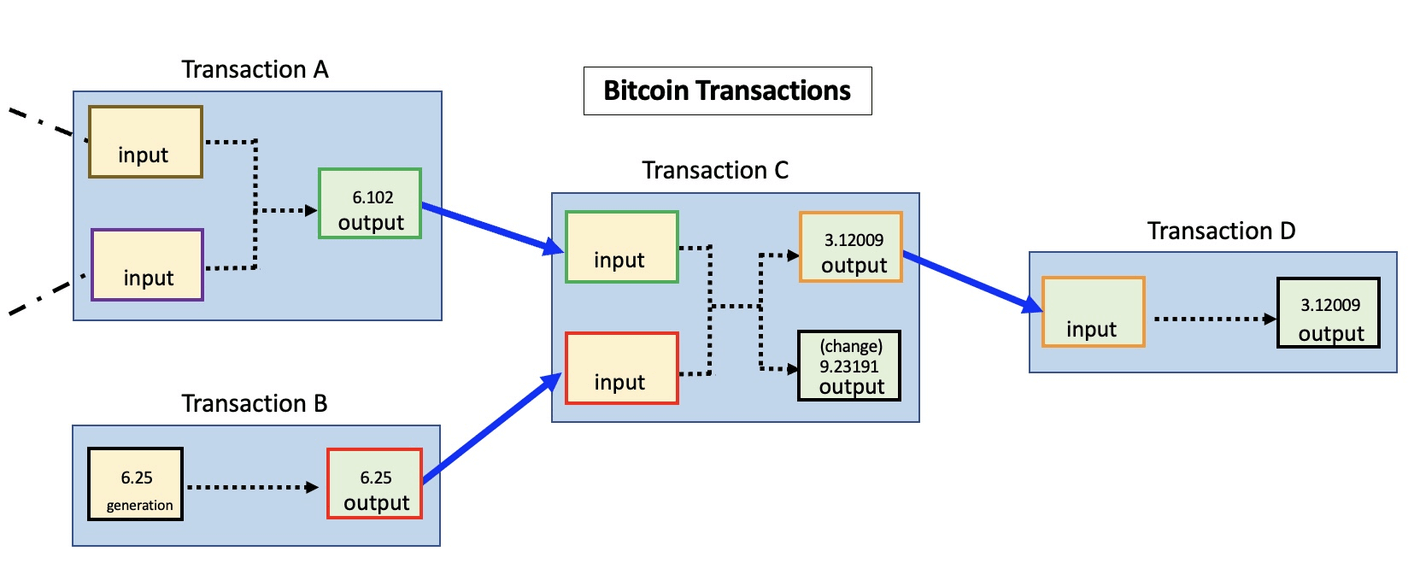
To understand how Bitcoin transactions work, consider the example illustrated in the following diagram. In Transaction A, a user sends 6.102 BTC to another user, referred to as C. Meanwhile, in Transaction B, user C generates 6.25 BTC. In Transaction C, C decides to send 3.12009 BTC to another user, D, while also sending a portion of the BTC back to themselves as change, totaling 9.23191 BTC. Finally, in Transaction D, user D sends 3.12009 BTC to another party, though this output has not yet been redeemed. In the current state of the blockchain, only D’s output and C’s change are spendable. This sequence of transactions highlights the intricate nature of Bitcoin’s system, where each input must be balanced by an output, and where change is often returned to the sender to ensure accurate accounting.
Through these mechanisms, Bitcoin maintains its integrity and security, providing a reliable method for peer-to-peer transactions without the need for a central authority.
Bitcoin Transactions
Bitcoin Mining: Process and Profitability
Bitcoin mining is the process of validating transactions and adding them to the blockchain. This process requires significant computational power, which is provided by specialized mining hardware known as ASICs (Application-Specific Integrated Circuits). These machines are designed specifically for mining and are far more efficient than traditional computers. Miners also need mining software to connect their hardware to the Bitcoin network and manage their mining operations. The profitability of mining is influenced by several factors, including the cost of electricity, the efficiency of the mining hardware, and the current difficulty of the mining algorithm. To increase their chances of earning Bitcoin, many miners join mining pools, where they combine their computational resources and share the rewards. ROI (Return on Investment) for mining can vary significantly, and tools like bitcoin mining calculators are used to estimate potential earnings. Despite the high costs and technical challenges, mining remains a lucrative activity for those who invest in the right equipment and operate in regions with low electricity costs.
Key factors that influence mining revenue include the current price of Bitcoin (BTC), the difficulty level of the mining algorithm, and the cost of electricity required to power mining hardware. Additionally, the efficiency of the mining equipment, such as ASIC miners, plays a crucial role in determining profitability. Market conditions, including network hash rate and block rewards, also directly impact revenue. Miners must continually assess these factors to maximize their return on investment (ROI) and ensure that their operations remain profitable in the highly competitive and volatile cryptocurrency market. In previous articles, we introduced some of the most efficient ASIC miners. Please feel free to contact us if you have any inquiries or requests regarding them.
The Future of Bitcoin
The future of Bitcoin is a topic of much debate and speculation. As the first and most established cryptocurrency, Bitcoin is likely to remain a central player in the digital currency space. However, several challenges could shape its future trajectory. One significant concern is the energy consumption associated with Bitcoin mining. The Proof of Work algorithm requires massive amounts of computational power, leading to high energy usage, which has sparked environmental concerns. Advancements in mining technology, such as more energy-efficient ASIC miners and potential shifts to alternative consensus mechanisms, could address these issues.
Regulatory developments also play a crucial role in Bitcoin’s future. In a recent speech, former President Trump reiterated his skepticism about cryptocurrencies, emphasizing the need for stricter regulations. This stance highlights the ongoing tension between governmental oversight and Bitcoin’s decentralized nature. As governments worldwide grapple with how to regulate cryptocurrencies, Bitcoin’s role as a decentralized currency might be challenged or strengthened, depending on the regulatory environment.
Additionally, the introduction of Bitcoin ETFs (Exchange-Traded Funds) has had a significant impact on the market. These financial instruments make it easier for institutional investors to gain exposure to Bitcoin, thereby increasing its legitimacy and attracting more mainstream adoption.